STATS19 reported road casualties: LA region of Bristol
Introduction
This is a report for the Local Authority (LA) region of Bristol, which can be reproduced for any LA by cloning the repository at https://github.com/blaisekelly/stats19_stats. #The LA boundary is shown on this plot of the cycle network (from OSM data processed with the osmactive package).
In this report all serious and slight casualty data is based on the adjusted data.
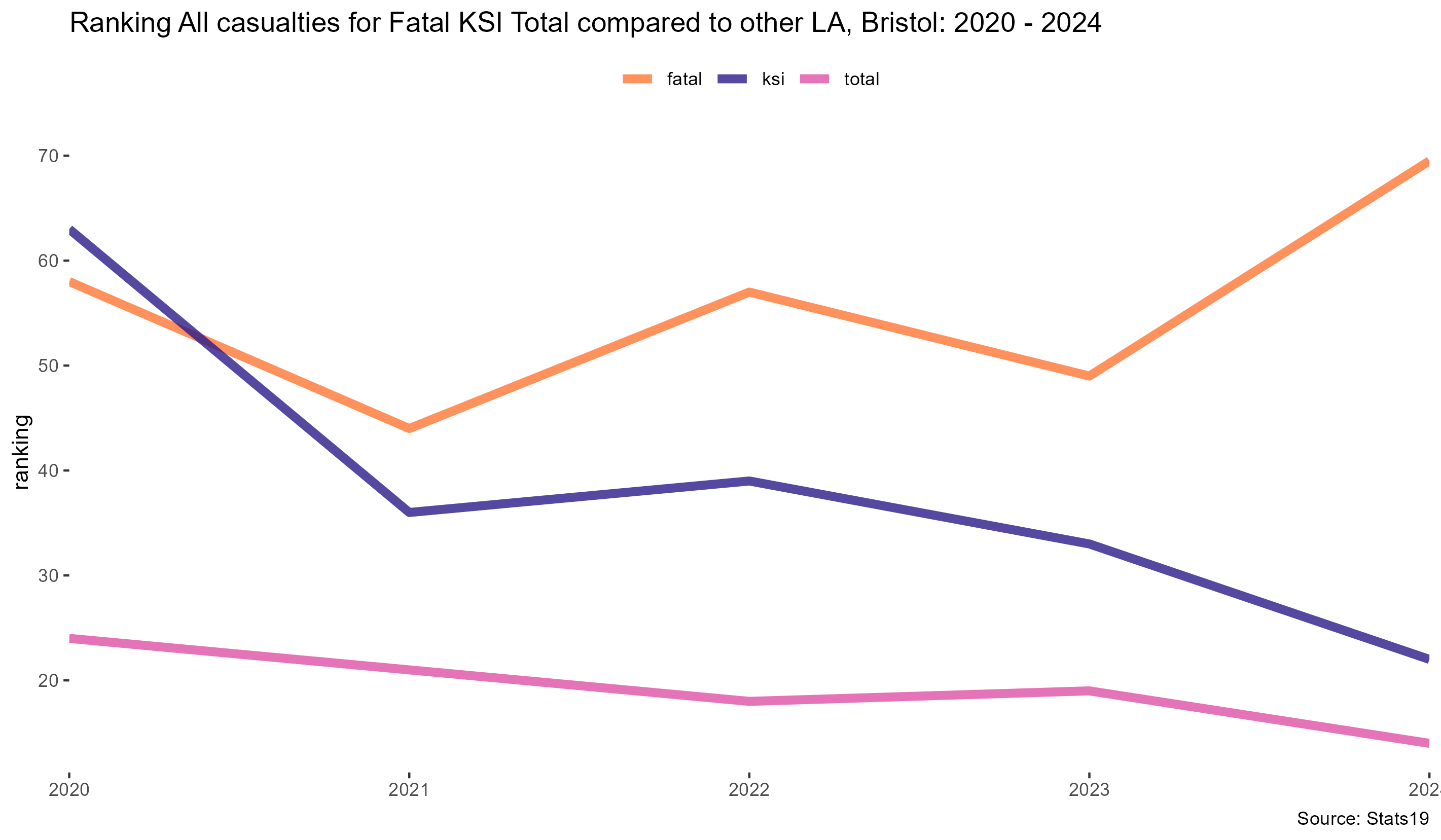
In 2025, Bristol had 745 collisions involving all casualty types resulting in 835 casualties reported to the police. This is the 21st highest of 374 Local Authorities in Great Britain (23rd per capita) and a decrease in collisions of 89 but a decrease in total casualties of 112. For fatal it ranked 307th ( 23rd per capita) with 1 casualties down on 2024. For KSIs it ranked 14th (23rd per capita) with 207 casualties down on 2024. For serious injuries it ranked 12th (23rd per 1000) with 206 casualties down on 2024. For slight injuries it ranked 28th (23rd per 1000) with 628 casualties down on 2024.
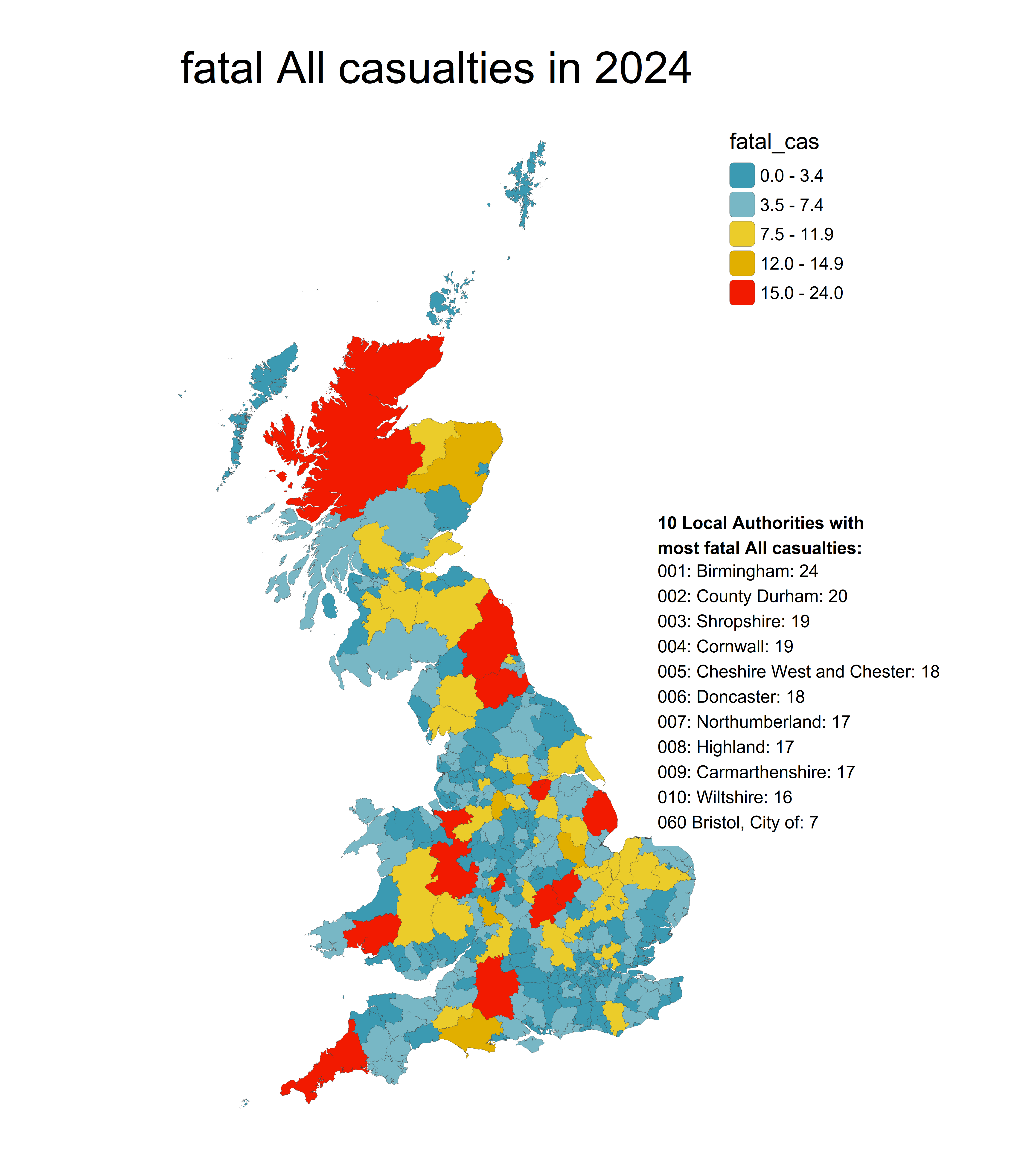
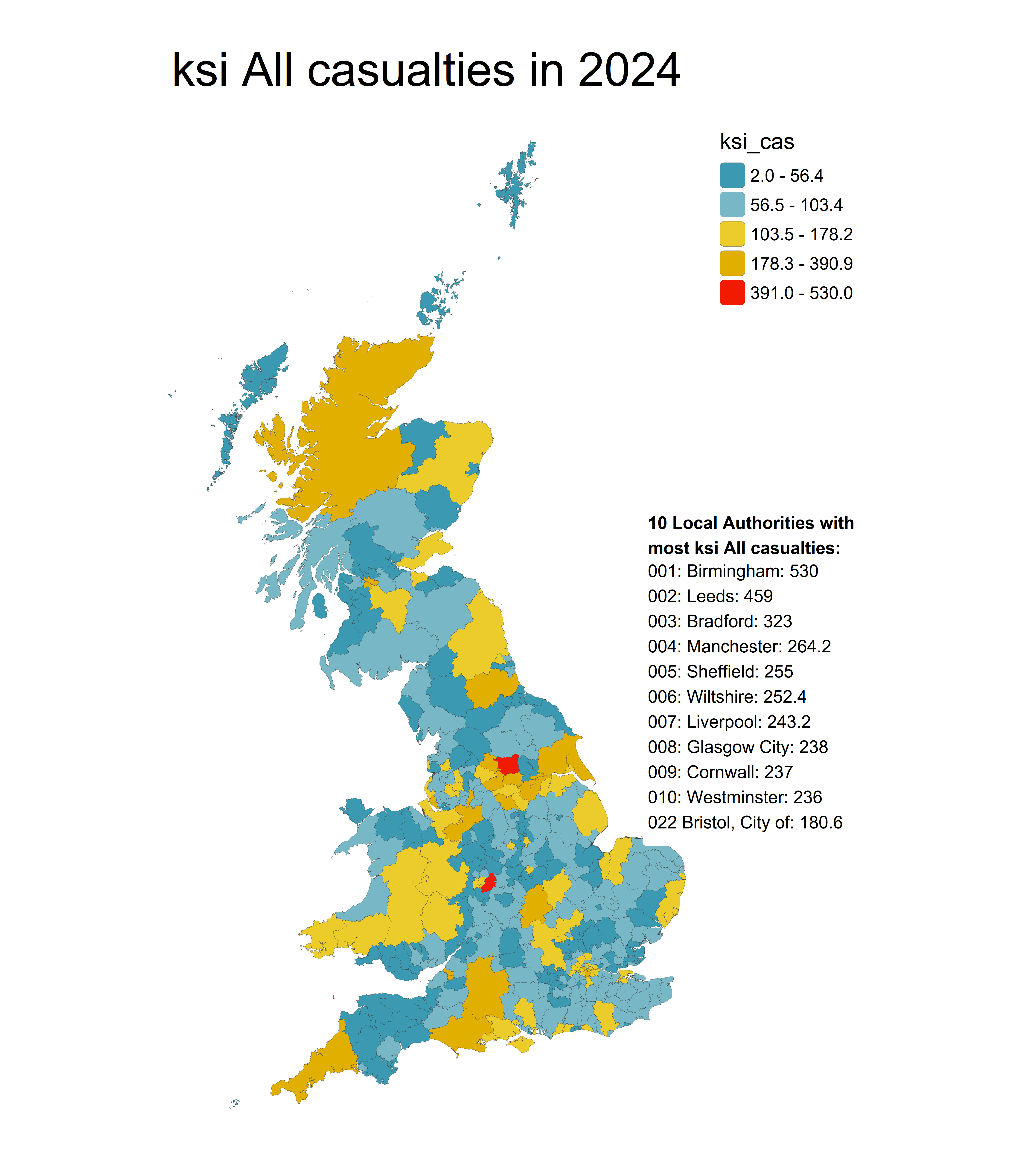
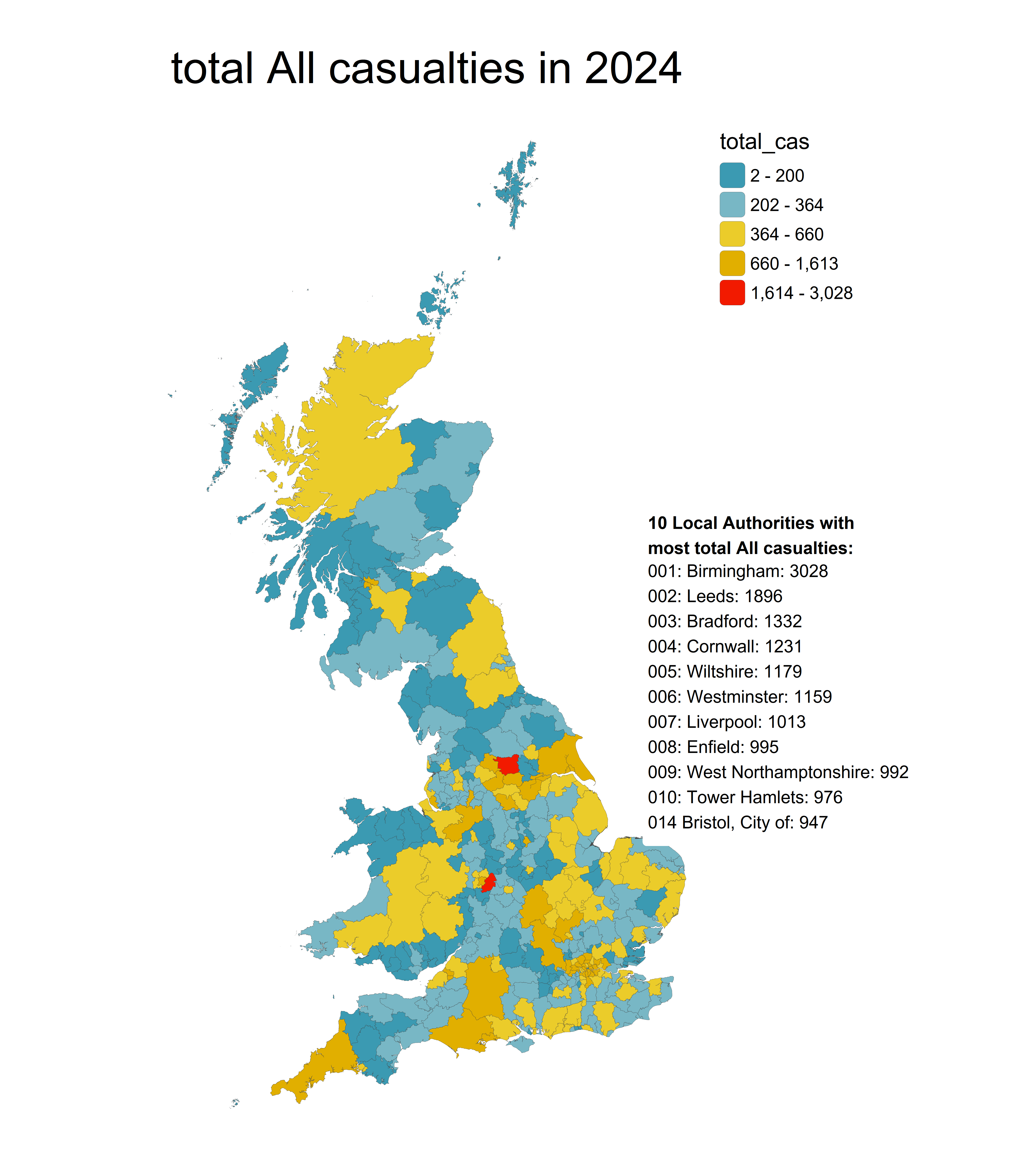
Compared to 5 years ago collisions are down by 89, total casualties down by 80, fatalities down by 7, KSI casualties up by 5, serious injuries up by 12 and slight injuries down by 85.
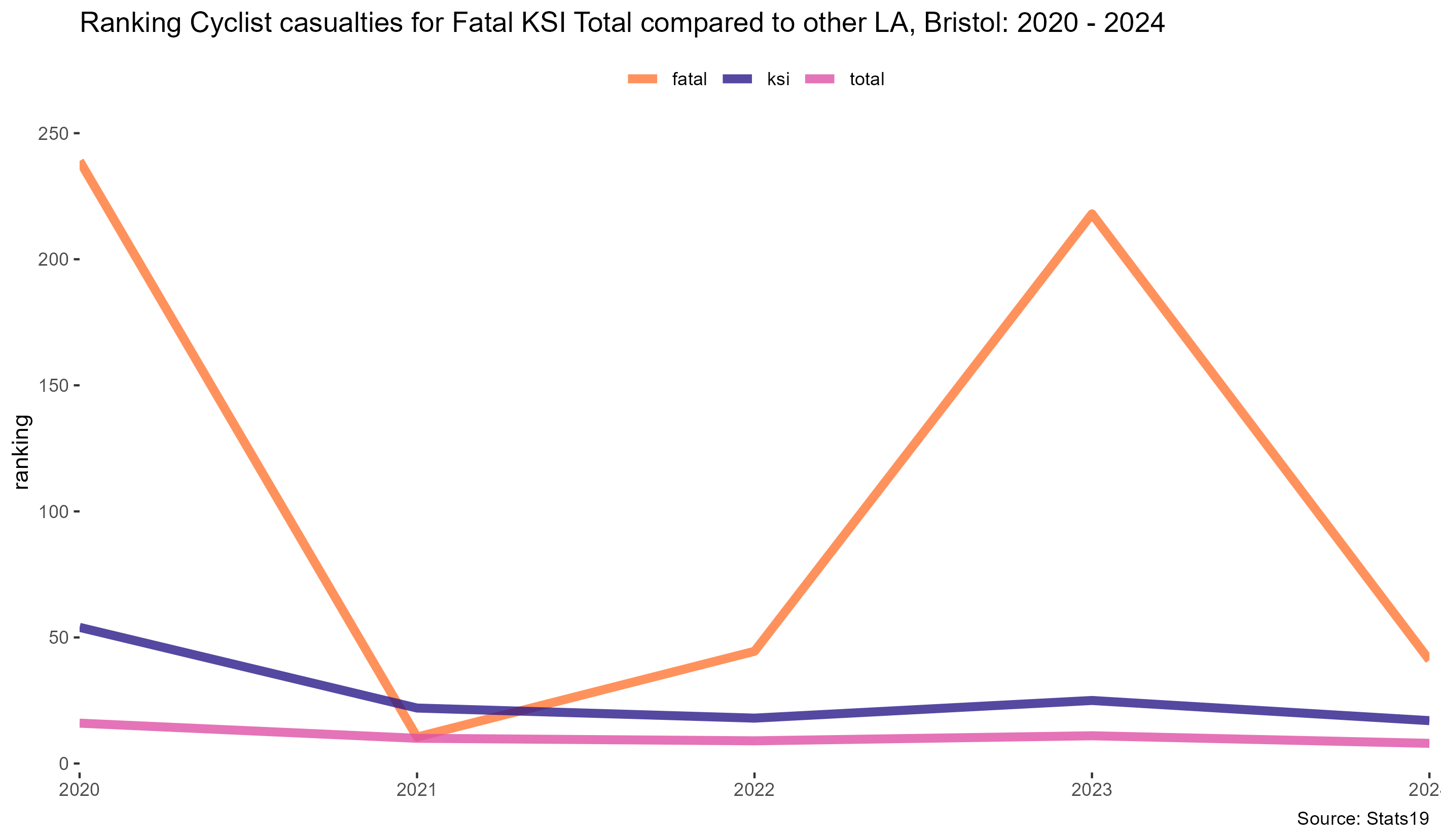
For cyclists there were 199 collisions resulting in 200 cyclist casualties reported to the police. This is the 12th highest of 374 Local Authorities in Great Britain (23rd per capita) and a decrease in collisions of 32 but a decrease in total casualties. For fatal it ranked 40th (23rd per capita) with 1 cyclist casualties down on 2024. For KSIs it ranked 9th ( 23rd per capita) with 63 casualties up on 2024. For serious injuries it ranked 9th (23rd per 1000) with 62 cyclist casualties up on 2024. For slight injuries it ranked 14th (23rd per 1000) with 137 cyclist casualties down on 2024.
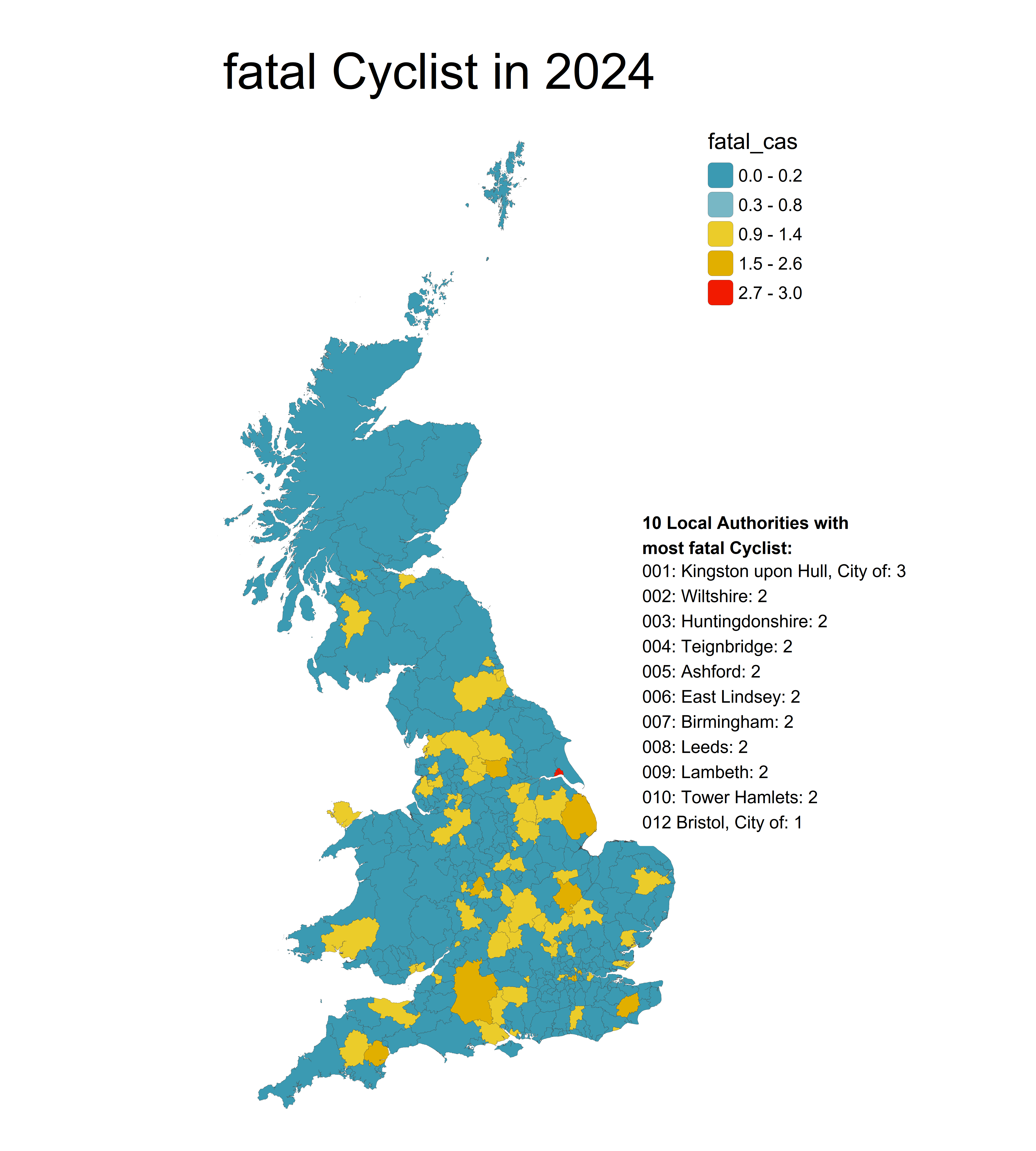
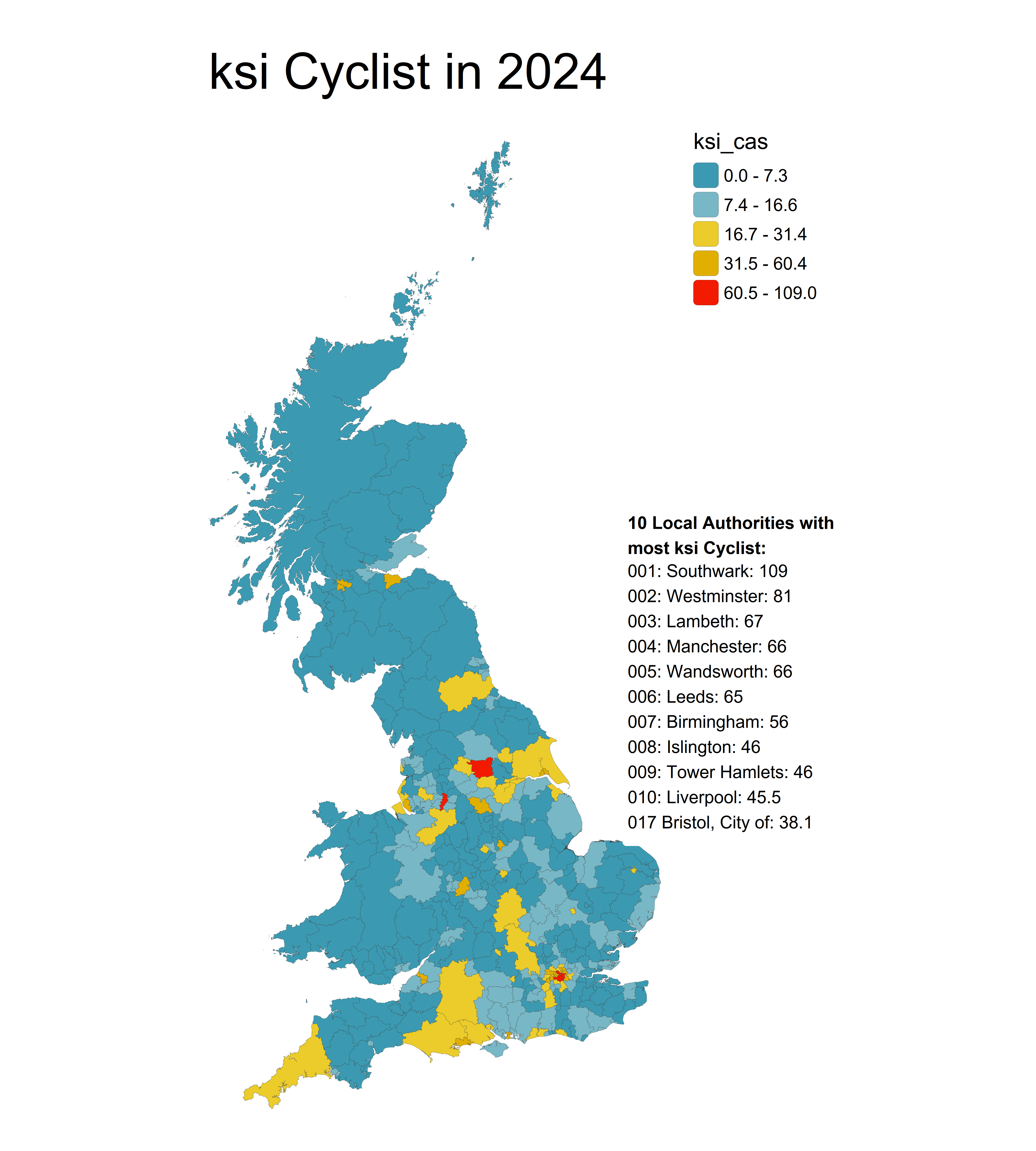
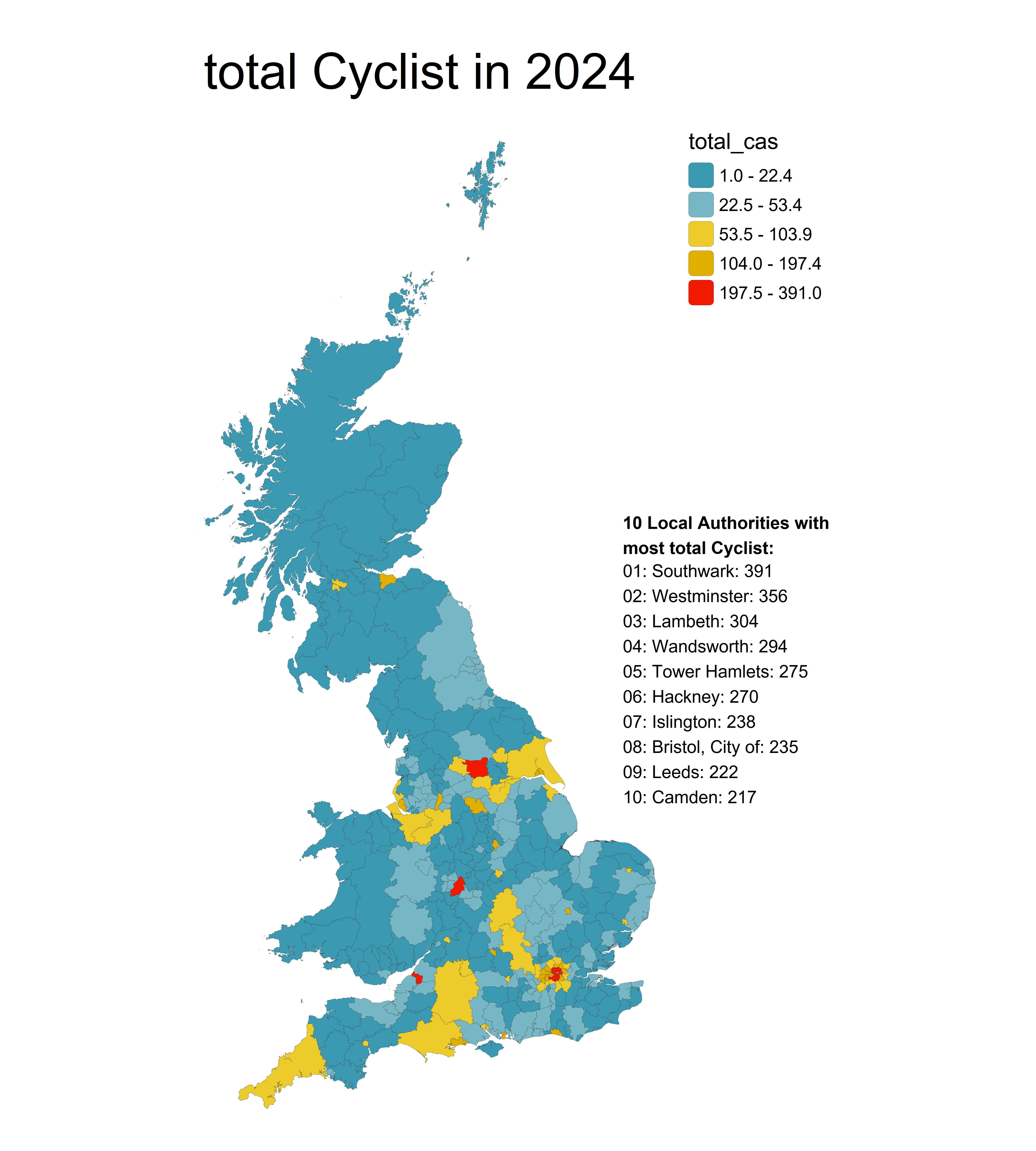
Compared to 5 years ago collisions involving cyclists are down by 13, total casualties down by 14, fatalities down by 1, KSI casualties up by 7, serious injuries up by 8 and slight injuries down by 21.
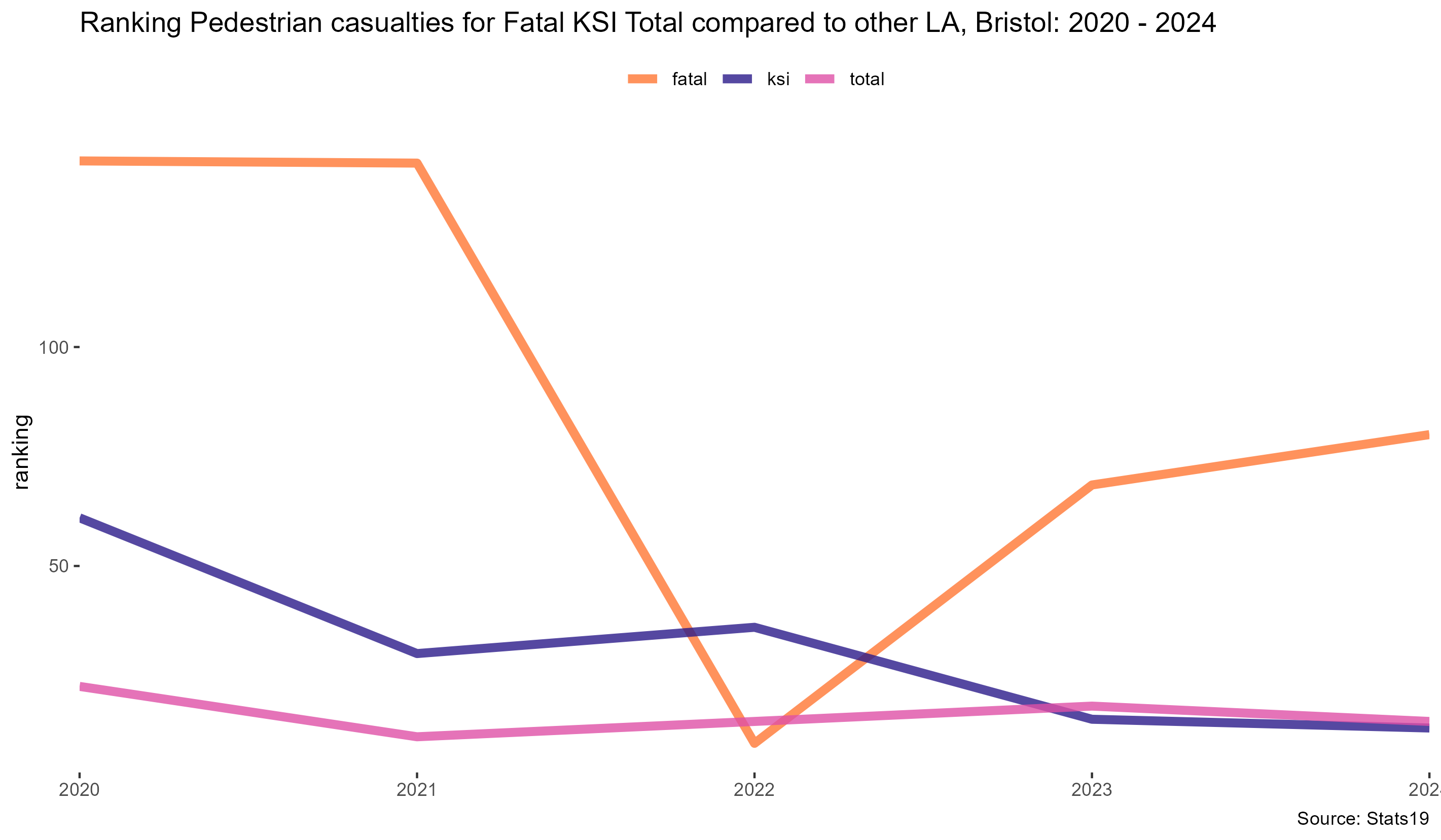
For pedestrians there were 144 collisions resulting in 146 pedestrian casualties reported to the police. This is the 26th highest of 374 Local Authorities in Great Britain (23rd per capita) and a decrease in collisions of 22 and a decrease in total casualties. For fatal it ranked 284th (23rd per capita) with 0 pedestrian casualties down on 2024. For KSIs it ranked 24th (23rd per capita) with 44 casualties down on 2024. For serious injuries it ranked 22nd (23rd per capita) with 44 pedestrian casualties down on 2024. For slight injuries it ranked 26th (23rd per capita) with 102 pedestrian casualties down on 2024.
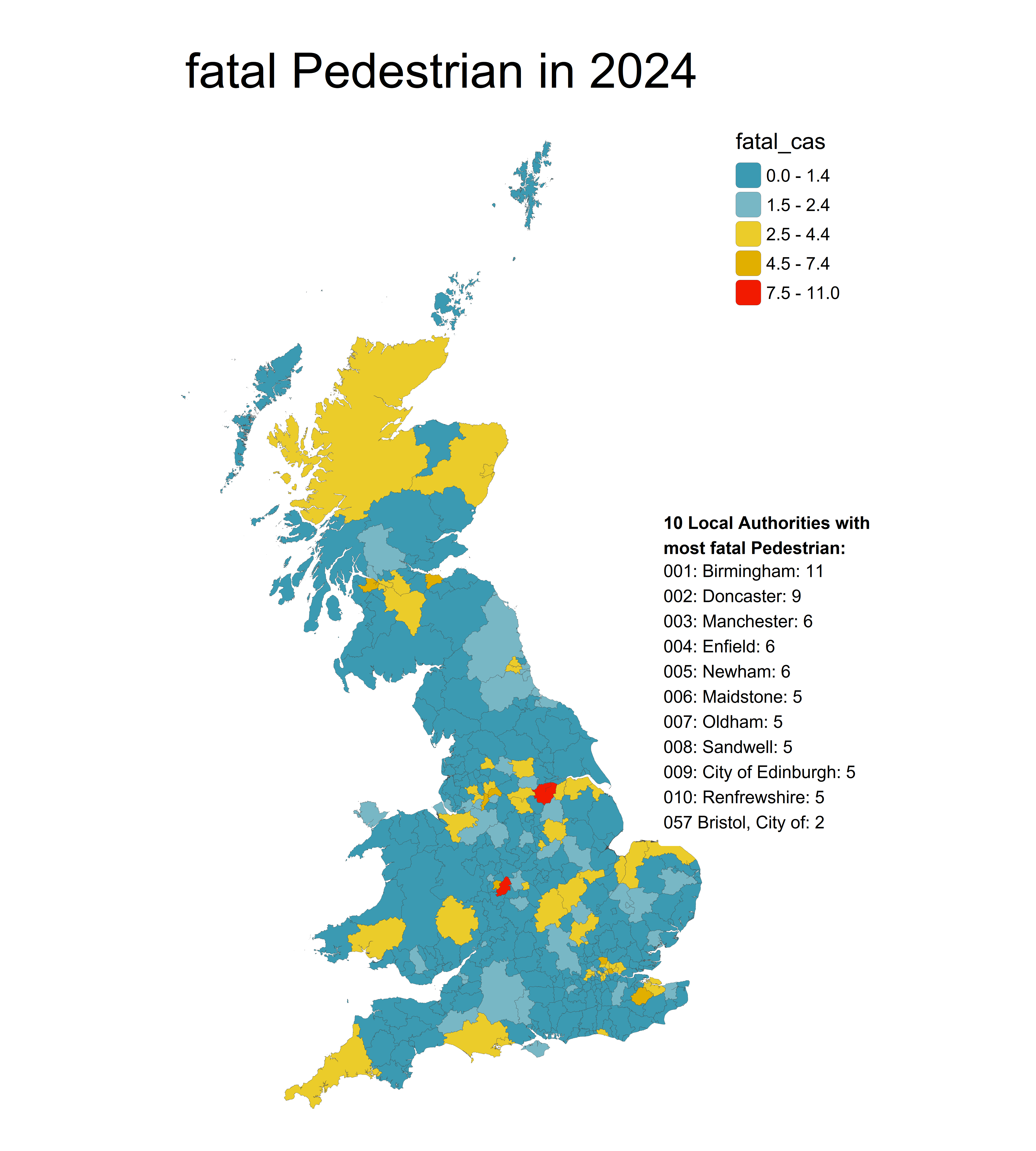
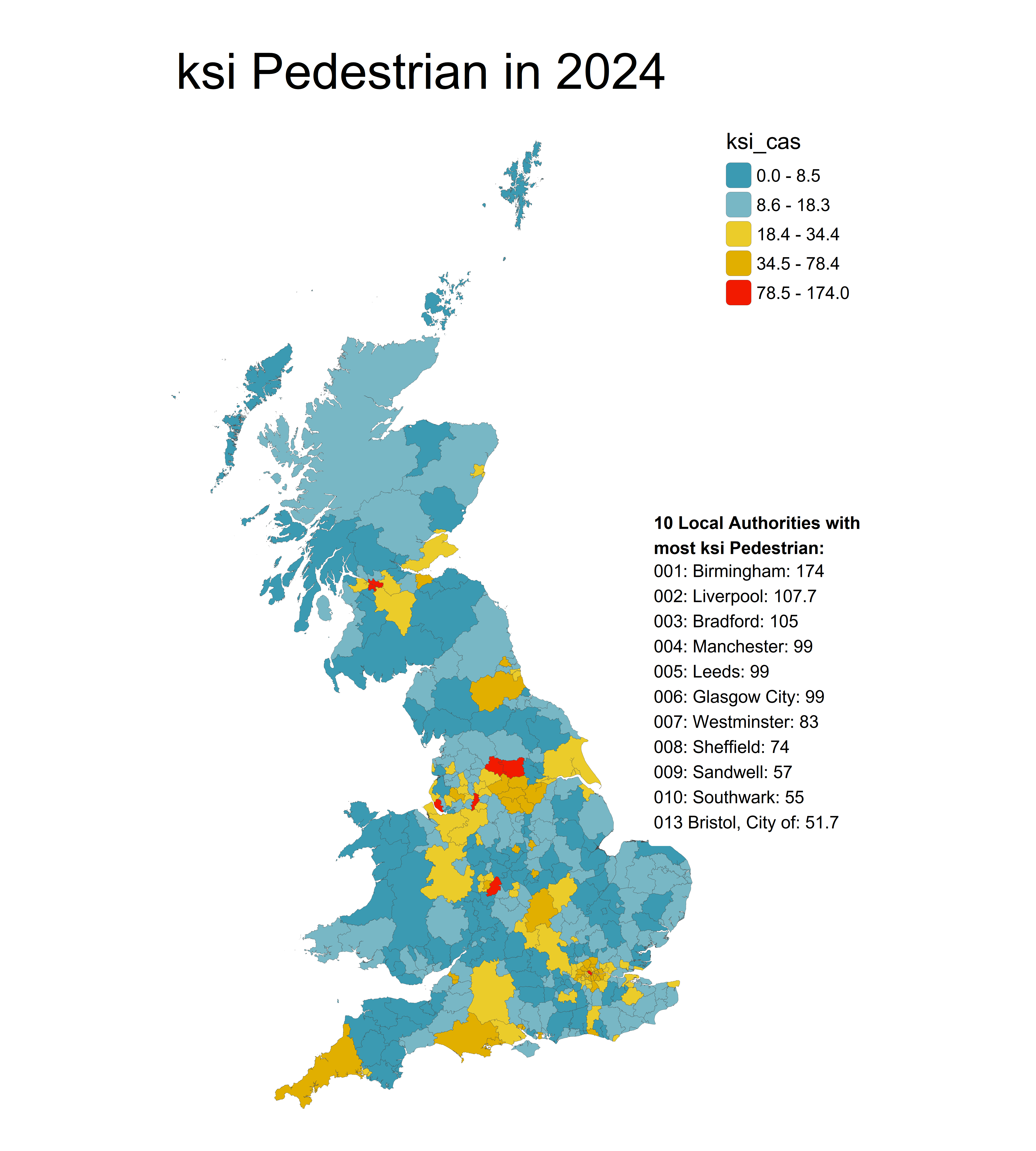
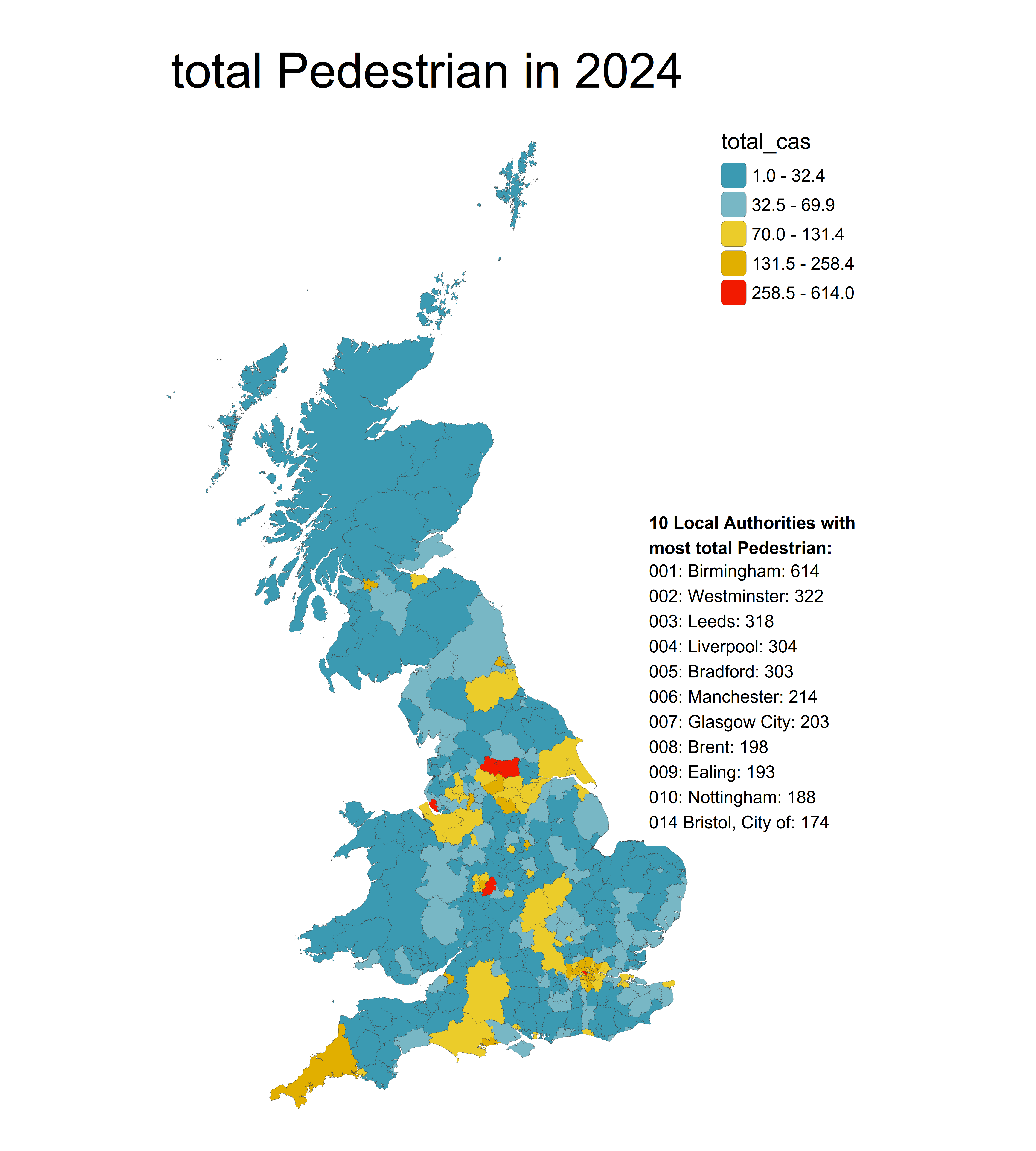
Compared to 5 years ago collisions involving pedestrians are down by 11, total casualties down by 15, fatalities down by 1, KSI casualties down by 6, serious injuries down by 5 and slight injuries down by 9.
Where in Bristol?
The interactive map at this link shows the location of all collisions between 2021 and 2025 sized by severity of the casualties and coloured by the speed limit of the road it took place on and dissagregated by casualty using the radio buttons. Clicking on each casualty provides further information about the casualty. (note: sometimes when first loading the casualty types need to be toggled a few times before they show the correct corresponding dots, clue is that bus occupants don’t make up many casualties) # {r, fig.width=100%} # #| echo: false # knitr::include_graphics("https://blaisekelly.github.io/stats19_stats/outputs/Bristol/maps/cas_location_Speed%20limit.html") # #
Grouping by street, using Open Street Maps data, the map at this link shows the collisions for each street coloured by KSI and dissagregated by year. Each street can be clicked to activate a pop-up with more details.
Road Network Analysis
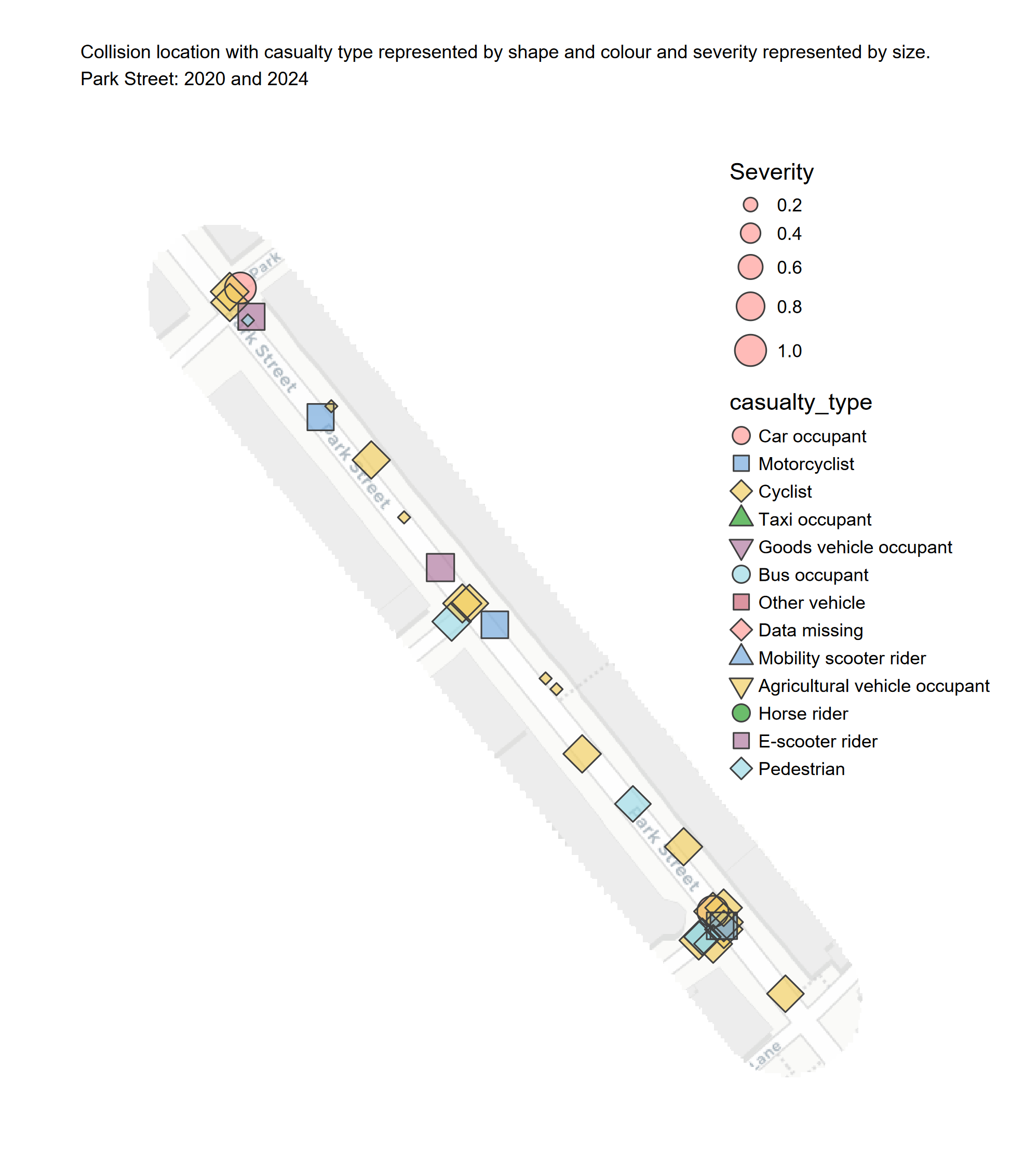
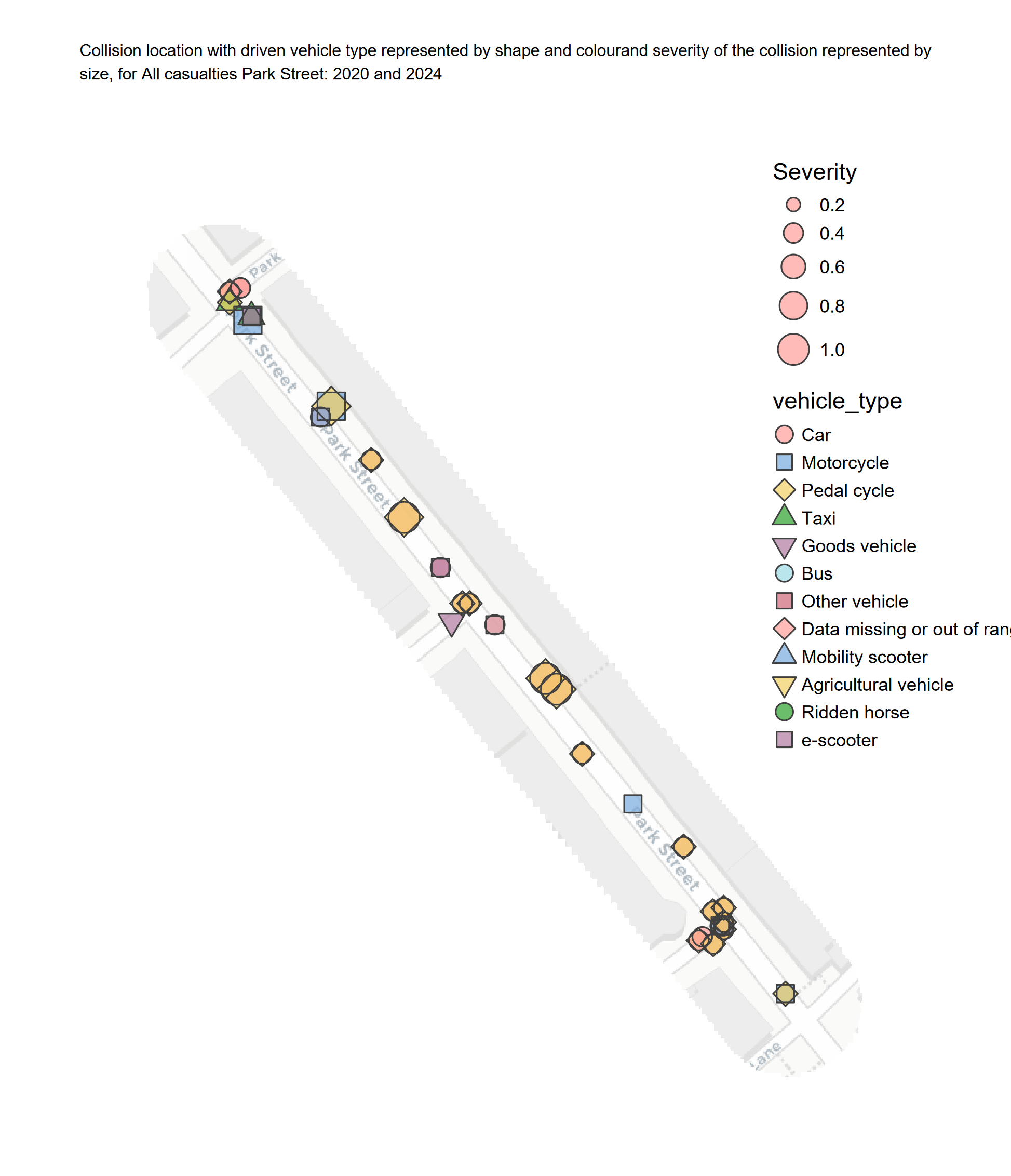
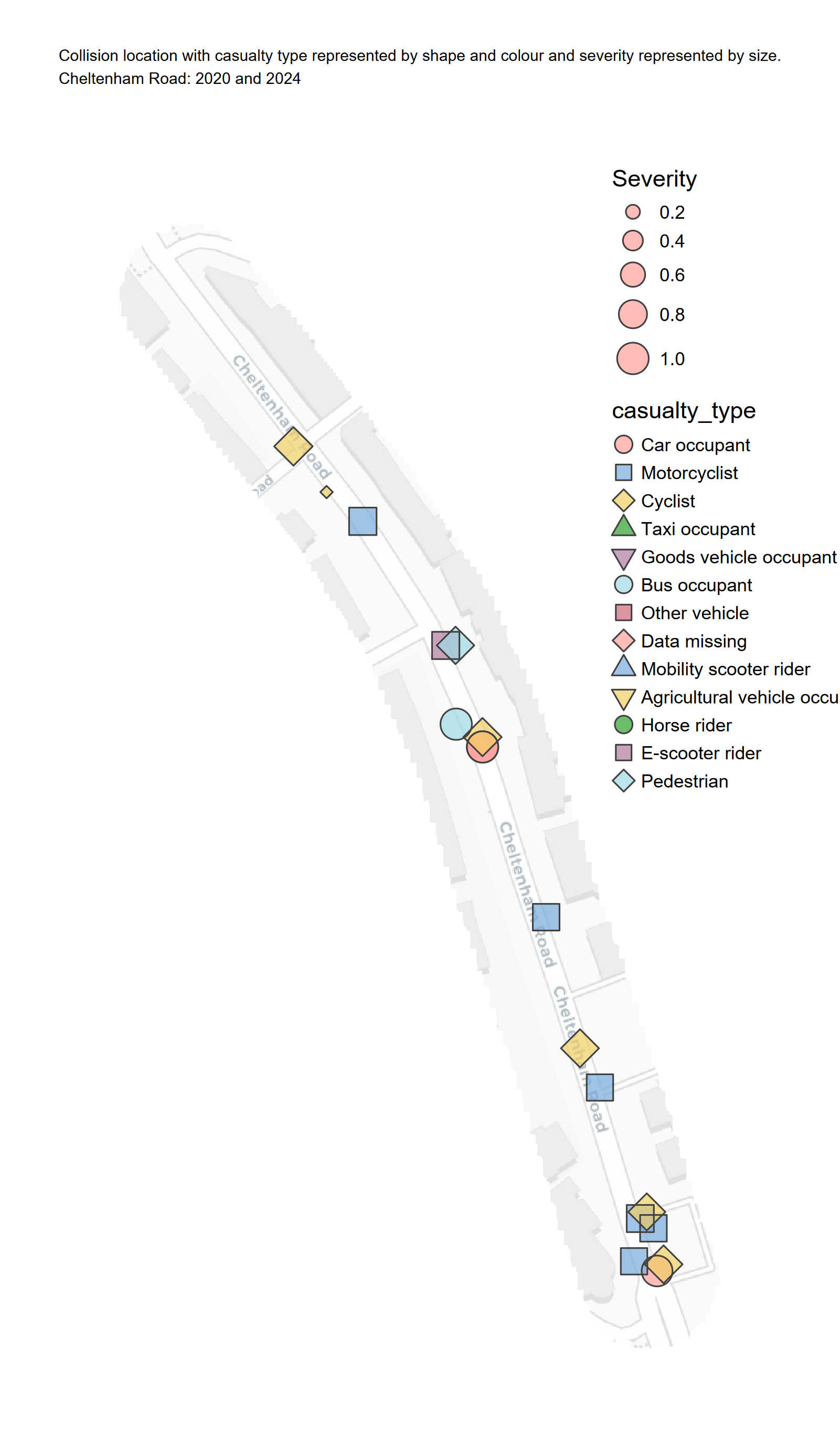
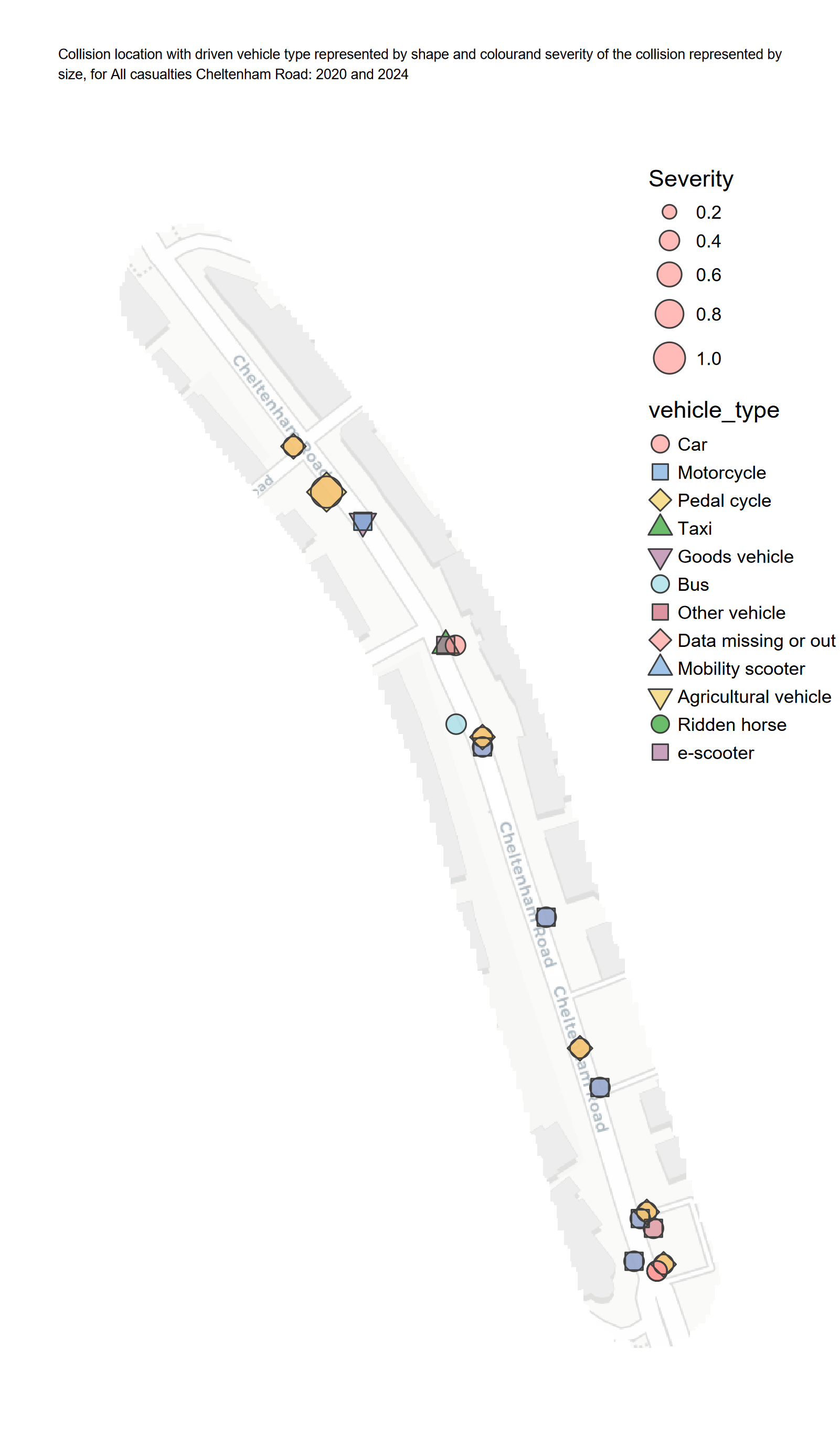
Casualty data was matched to 2218 road links from OpenStreetMap for the period 2021 to 2025, covering 4102 collisions. The road with the highest number of collisions was Park Street (23), followed by Cheltenham Road (20). Across 5 years the peak year for collisions on mapped roads was 2022 with 871 collisions. By casualty type the most common on the OSM network was Car occupant (1122 collisions). The table below shows the highest 20 roads by collision count for the full period. Click a header to sort the column.
The plots below show plots of collisions of the 2 roads with the most collisions in Bristol: Park Street and Cheltenham Road. The plot on the left represents the casualties and the plot on the right vehicles involved. To see a plot larger, right click and either save or “open in new tab”.
Speed Limits: Casualty rates by road speed limit
In Bristol, according to OSM data the majority of roads are 20mph (58%). Between 2021 and 2025 the majority of collisions (2392) happened on 20mph roads. (56)% of fatalities happened on 30mph roads, which make up 12% of roads in the LA. 600 casualties were seriously injured on 20mph roads. Collision rates per km are highest for 30mph roads, fatality rates highest on 30, 40mph roads, serious injury rates highest on 30mph and slight injury rates 30mph. The collision rate on 20mph roads was 34.8% lower than the highest roads (30mph) and fatality rates 8.3% of 30mph roads and 8.3% of the highest fatality rate (30, 40mph) roads. KSI rates were highest on 30mph roads, 3.2 times higher than 20mph roads.
The chart below shows percentage of fatalities by road speed limit.
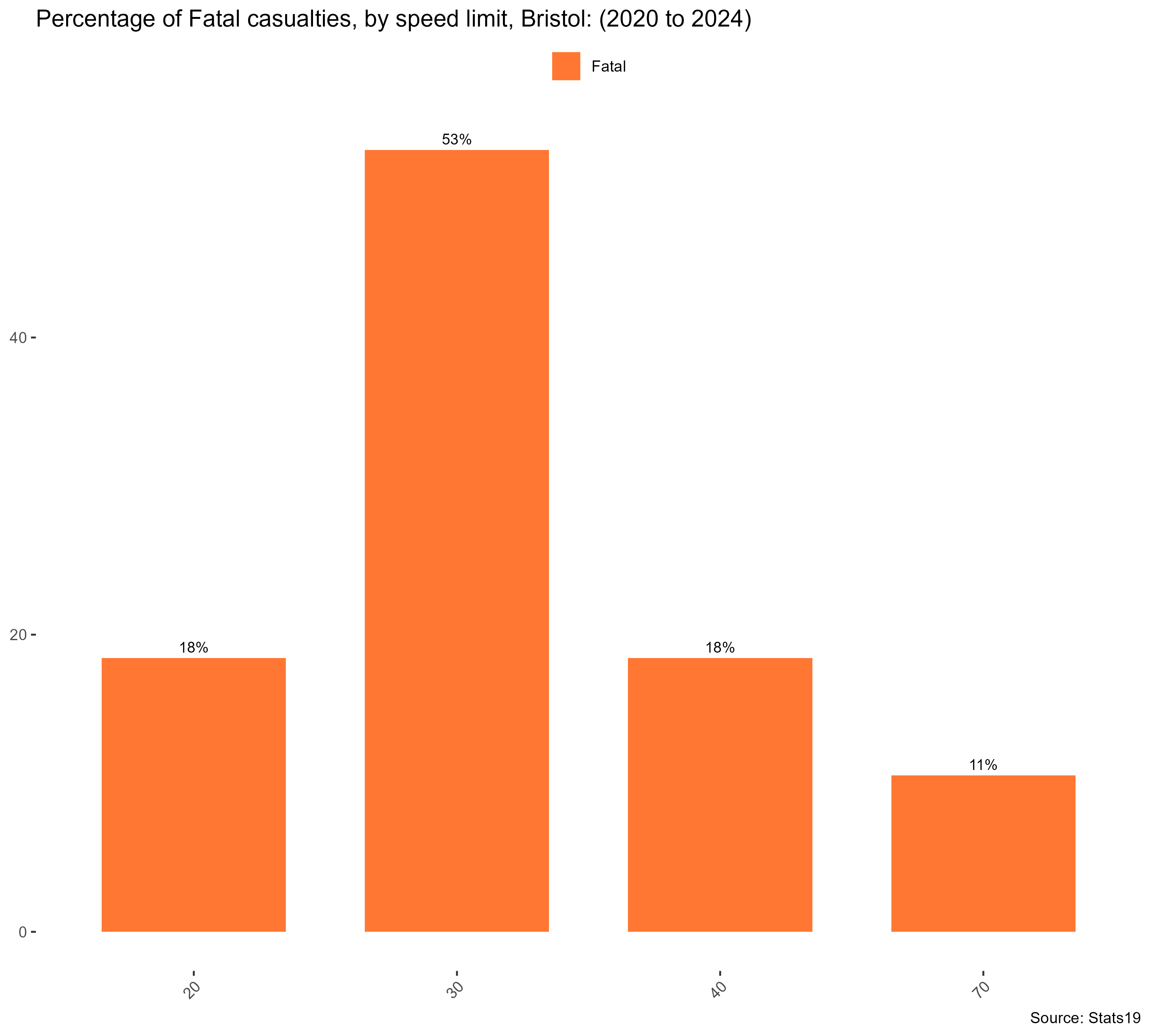
Applying the 30mph fatality rate (0.283) fatalities per 1000 collisions to the number of 20mph collisions would give 29 fatalities. Applying the per km rate of 9.49 to the 20mph road network would give a staggering 87 fatalities.
| Casualties and collisions by speed limit and road length, Bristol: 2021 to 2025 | ||||||||||||||||
| Speed Limit (mph) | Collisions | Fatal | Serious | KSI | Slight | Total length (km) | % of LA roads | Collisions per km | Fatal per km | Serious per km | KSI per km | Slight per km | Fatal per collision | Serious per collision | KSI per collision | Slight per collision |
|---|---|---|---|---|---|---|---|---|---|---|---|---|---|---|---|---|
| 20 | 2392 | 6 | 600 | 606 | 2003 | 724.5 | 58.3 | 3.30 | 0.01 | 0.83 | 0.84 | 2.76 | 0.003 | 0.251 | 0.253 | 0.837 |
| 30 | 1442 | 18 | 390 | 408 | 1269 | 152.0 | 12.2 | 9.49 | 0.12 | 2.57 | 2.68 | 8.35 | 0.012 | 0.270 | 0.283 | 0.880 |
| 40 | 213 | 6 | 60 | 66 | 197 | 51.6 | 4.2 | 4.13 | 0.12 | 1.16 | 1.28 | 3.82 | 0.028 | 0.282 | 0.310 | 0.925 |
| 50 | 12 | 0 | 5 | 5 | 10 | 2.1 | 0.2 | 5.71 | 0.00 | 2.38 | 2.38 | 4.76 | 0.000 | 0.417 | 0.417 | 0.833 |
| 60 | 2 | 0 | 1 | 1 | 1 | 4.2 | 0.3 | 0.48 | 0.00 | 0.24 | 0.24 | 0.24 | 0.000 | 0.500 | 0.500 | 0.500 |
| 70 | 41 | 2 | 13 | 15 | 48 | 27.4 | 2.2 | 1.50 | 0.07 | 0.47 | 0.55 | 1.75 | 0.049 | 0.317 | 0.366 | 1.171 |
| Source: DfT STATS19 and OSM | ||||||||||||||||
Grouping by area and IMD
LSOA.
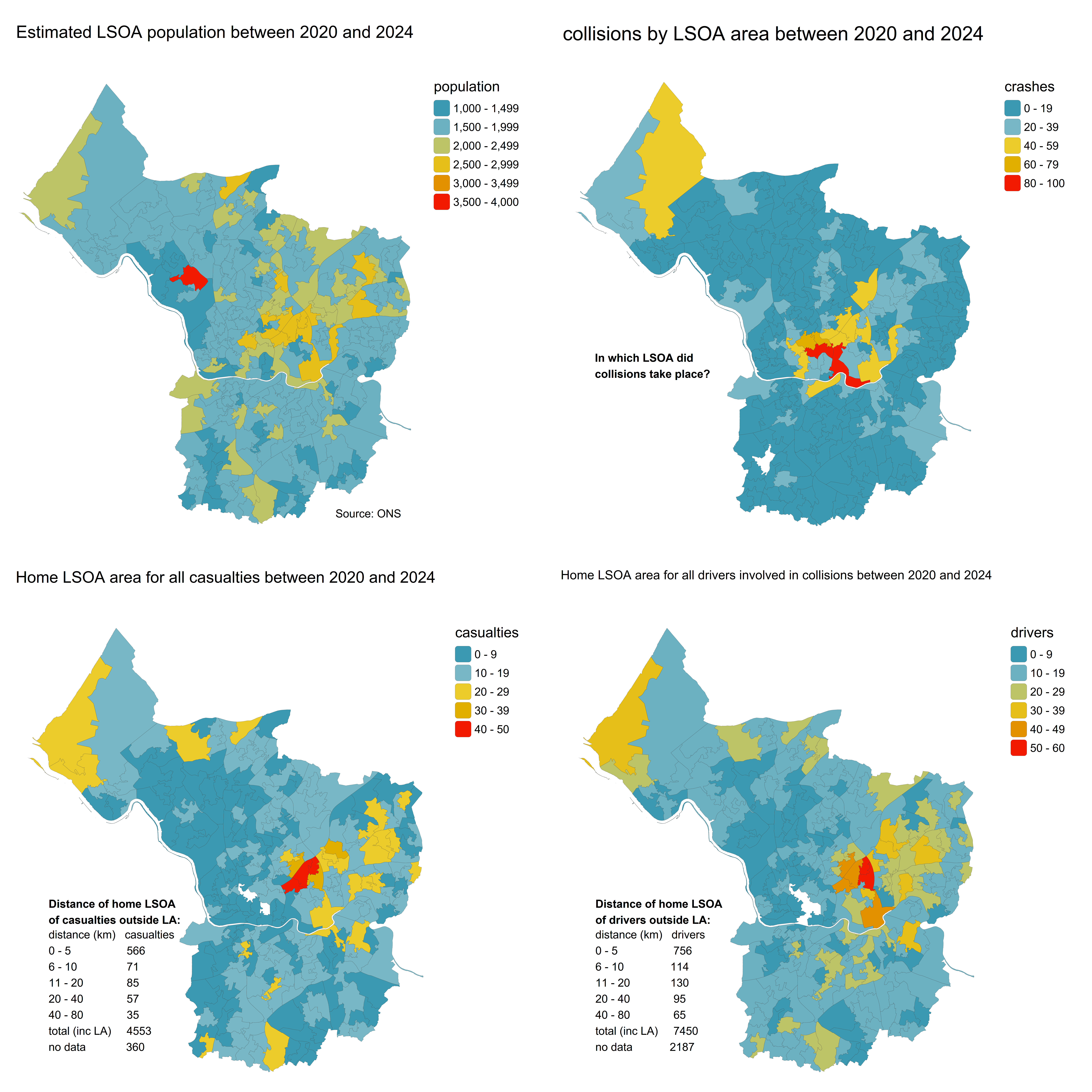
The top left plot below show the distribution of the population by LSOA zone, the most granular population data available for the whole of Great Britain. In the top right are the number of total collisions by LSOA zone, calculated by intersecting the crash data with the LSOA shape files and the bottom two plots shows the home LSOA of casualties and vehicles involved in collisions in the city.
Relationship with Index of Multiple Deprivation Decile (IMD)
The Index of Multiple Deprivation (IMD) is the official measure of relative deprivation in England and is part of a suite of outputs that form the Indices of Deprivation (IoD) given as a decile in the STATS19 casualty and vehicle data for the casualty and drivers home LSOA respectively. It follows an established methodological framework in broadly defining deprivation to encompass a wide range of an individual’s living conditions. It is important in road traffic collision analysis because it says something about where harm is distributed in society. In Bristol, 62.4, NA% of the population fall into the most, NA deprived IMD decile. 67.5, NA% of casualties injured between 2021 and 2025 fall into the most, NA deprived IMD decile. NA% of casualty data had home LSOA.
IMD and Casualties
The relationship between deprivation and road casualty risk is marked in Bristol. The most deprived IMD decile (decile 1) accounts for 7.1% of casualties (312), while the least deprived (decile 10) accounts for 4.7% (208). Residents of the most deprived areas are 1.5 times more likely to be a casualty than those in the least deprived decile. The decile with the highest number of casualties overall is decile 2 with 38 casualties (0.9%). As noted above, NA% of casualty records had a home LSOA that could be matched to an IMD decile, where as only xx of driver data had data on home location.
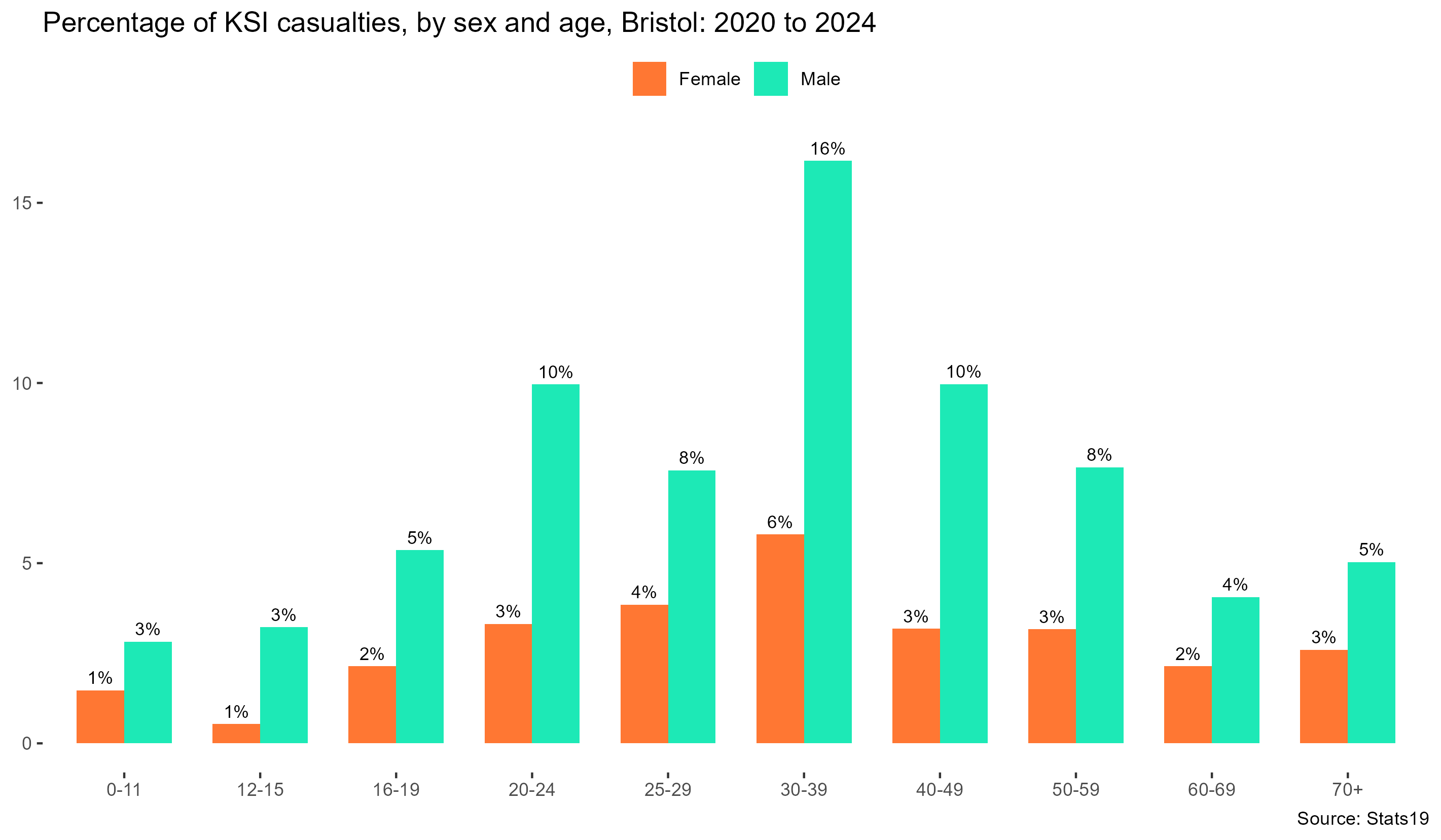
The charts below show a breakdown of the ages and sex number of KSI and IMD Decil of casualties in Bristol.
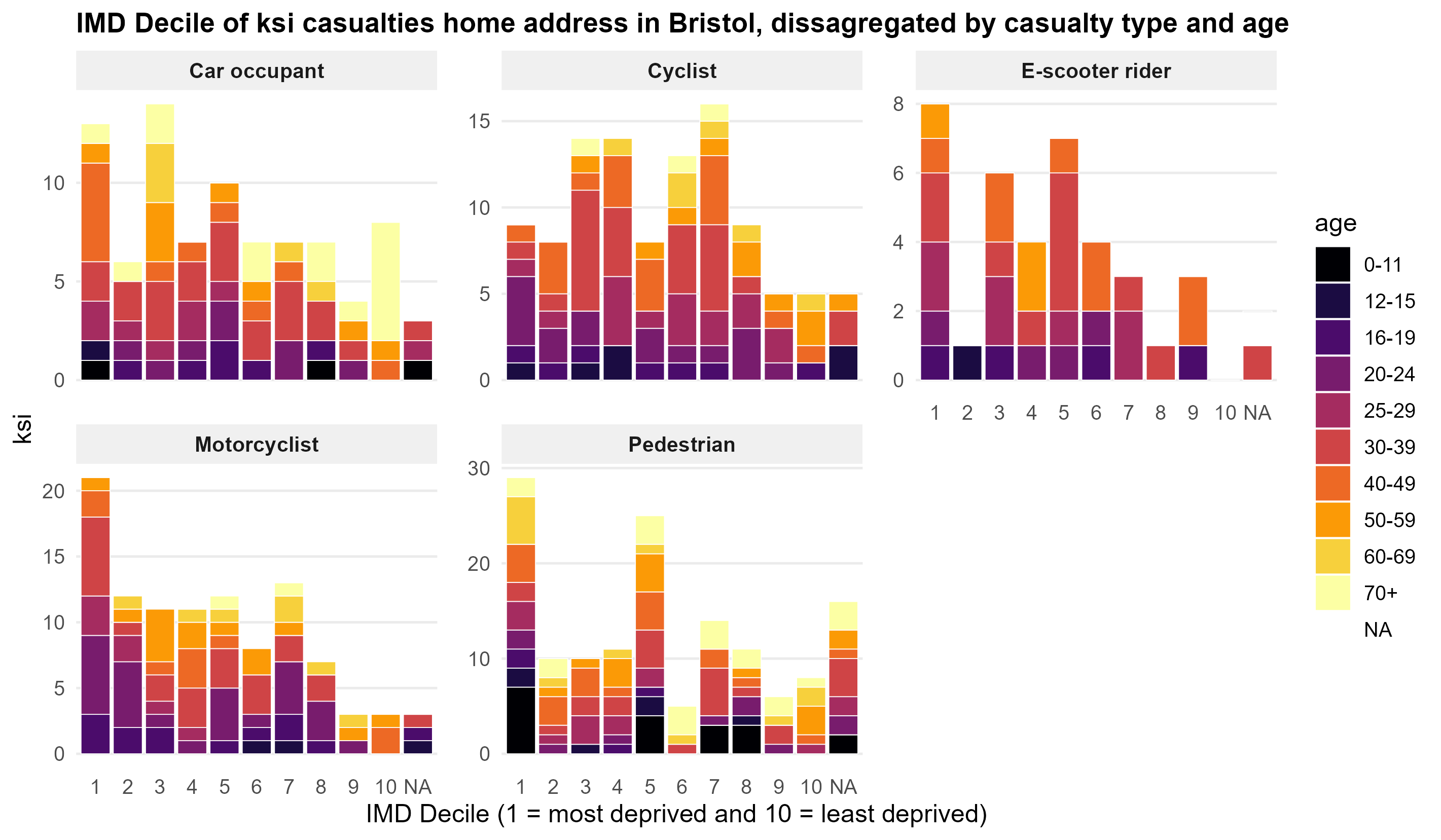
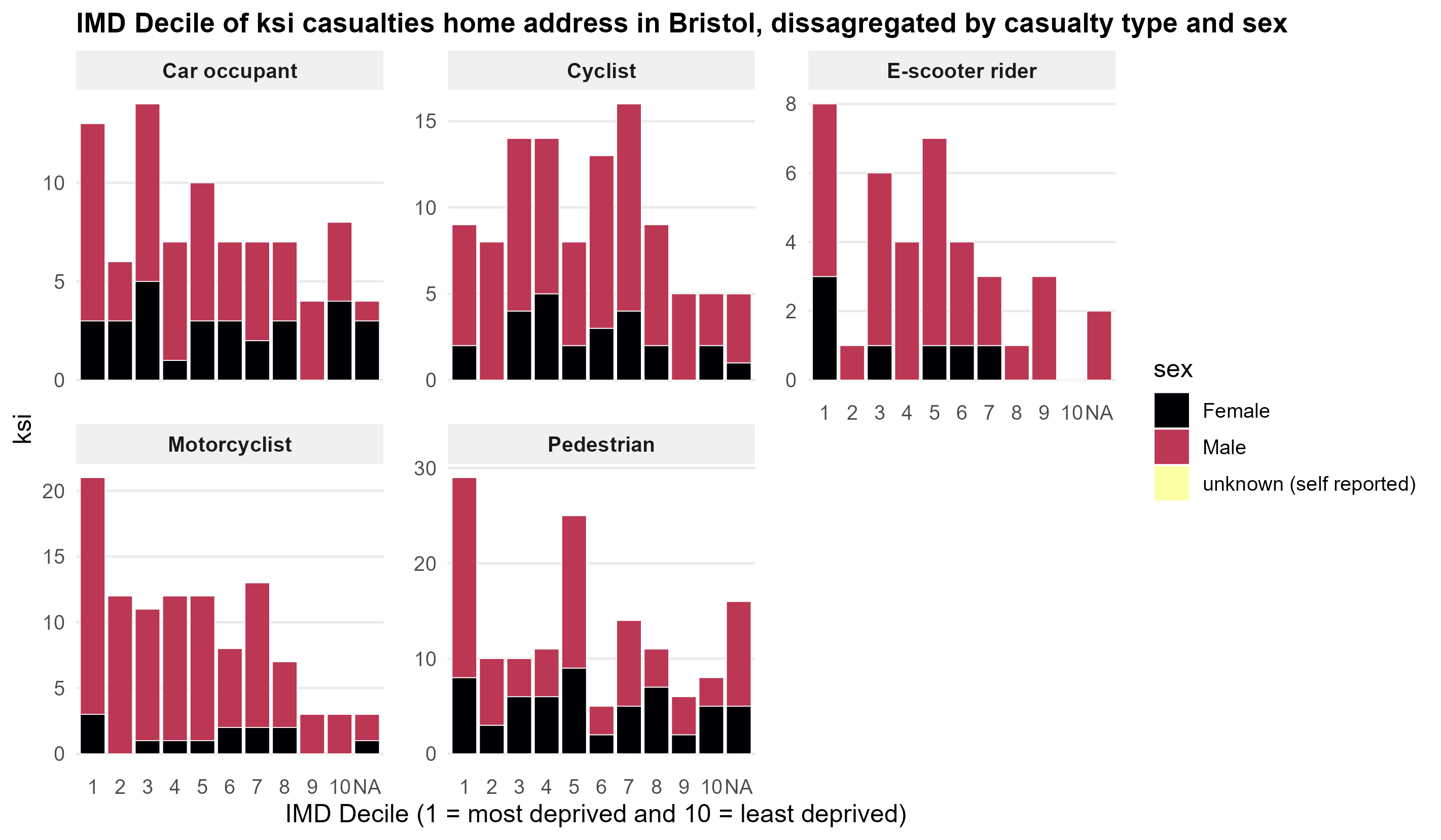
Analysis of KSI casualties by IMD decile in Bristol reveals that decile 2 (most deprived) accounts for the highest KSI total across casualty types combined, with approximately 187 KSI casualties. Cyclists represent the highest KSI casualty type overall (~273). Pedestrian KSI peaks in decile 2, while cyclist KSI is highest in decile 4. By age, the most affected groups are 30-39 for pedestrians, 30-39 for cyclists, and 30-39 for motorcyclists. Males account for approximately 725 KSI casualties compared to 287 for females.
MSOA
Between LSOA and Local Authority are Medium Super Output Levels (MSOA). Because of their relatively consistent size across the country, they are a useful unit for analysing data about small local areas and they also have been allocated descriptive names by the House of Commons Library makming it easier to describe areas. These areas have been used to analyse casualties by MSOA region and compare at a country level, similar to as has been done with LAs at the beginning of this document, but hopefully providing more targeted information for a local area.
Analysing the population weighted IMD from LSOA for MSOA for different casualty types, the strongest trends are for Car occupant, Motorcyclist casualties as shown in the plot below.
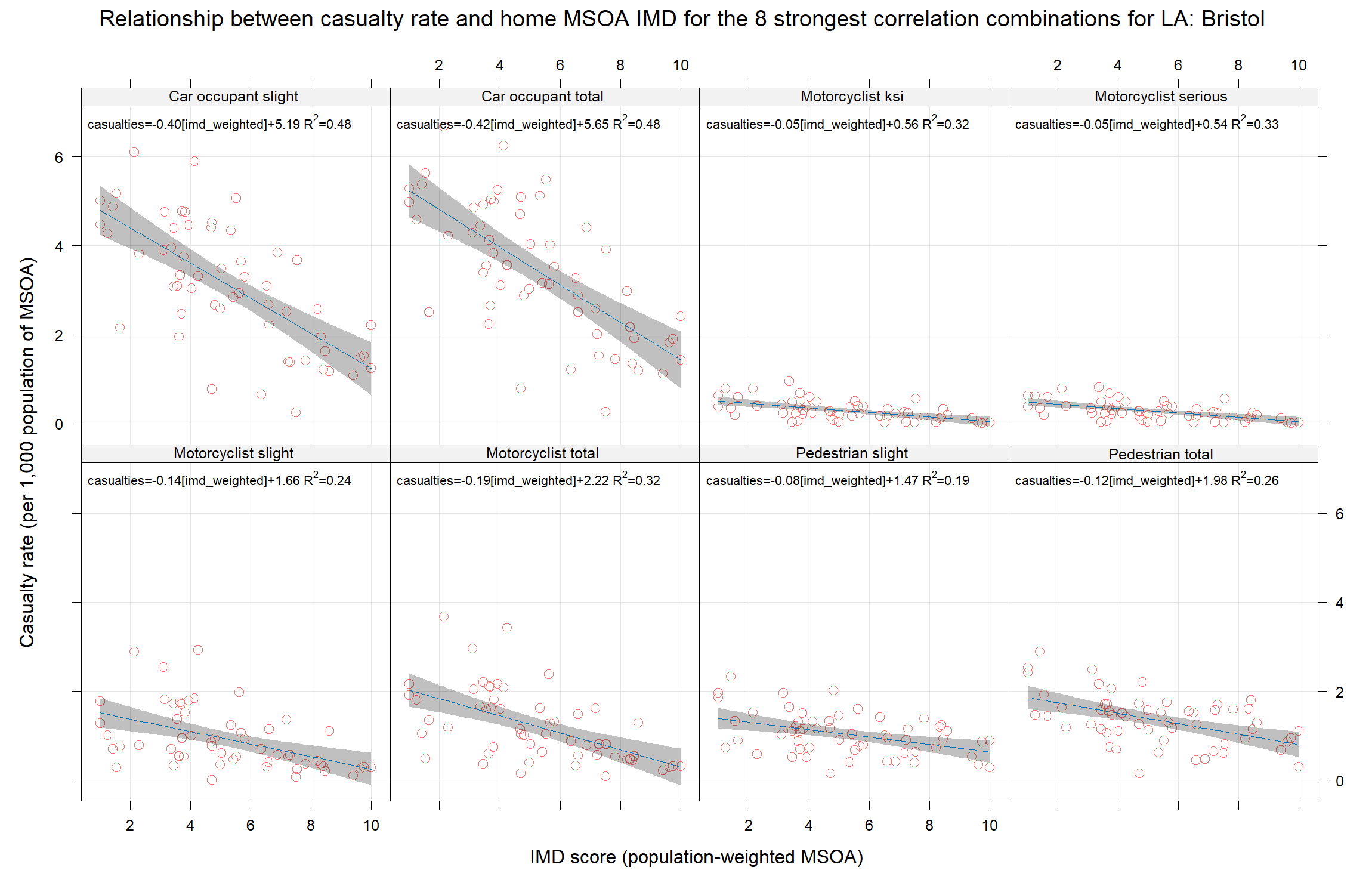
The table below shows data for the 57 MSOA areas in Bristol where casualties live and ranked against other MSOAs nationally. Casualties involved in collisions outside of Bristol are also included. Between 2021 and 2025, the MSOA with the highest number of casualties was Southmead with 154 casualties. The most deprived MSOA (by weighted IMD score) was Hartcliffe (IMD 10), while the least deprived was Westbury-on-Trym (IMD 1). The highest MSOA regions per capita where casualties live in Bristol are Sea Mills, ranked 417 nationally out of 7264 for fatalities per capita, Barton Hill ranked 215 for KSIs, Barton Hill ranked 164 for Serious casualties.
Casualty Demographics
Between 2021 and 2025, 63.9% of all casualties in Bristol were male and 36% were female. Males also accounted for 71.3% of KSI casualties. The most common age band for casualties was 30-39 (24.3% of all casualties), while the highest KSI rate was among the 30-39 age band (21.4% of all KSI). The table below shows the full breakdown of casualties by age band and sex, with severity and the percentage share of KSI and all casualties.
Single Vehicle Pavement Collisions
Between 2021 and 2025, nationally there were 10195 single-vehicle collisions where a pedestrian was struck on a footway or verge. 80% were people driving Cars, Taxis, Goods vehicles and Buses and 7% were people riding pedal cycles and e-scooters. Of these collisions there were 138 fatalities, 95% of these fatal collisions were with people driving Cars, Taxis, Goods vehicles and Buses and 1% died from collisions with people riding pedal cycles and e-scooters. A further 2547 serious injuries, 77% of the fatal collisions were with people driving Cars, Taxis, Goods vehicles and Buses and 9% from collisions with people riding pedal cycles and e-scooters.
In Bristol there were 109 reported incidents, resulting in 114 casualties. The vehicle type most commonly involved was Car with 45 collisions and 48 casualties. 63% of the vehicles in collisions were people driving Cars, Taxis, Goods vehicles and Buses and 6% were people riding pedal cycles and escooters. Of these collisions there were 3 fatalities, 100% of these collisions were with people driving Cars, Taxis, Goods vehicles and Buses and 0% from collisions with people riding pedal cycles and e-scooters. A further 18 serious injuries, 67% of which were with people driving Cars, Taxis, Goods vehicles and Buses and 11% from collisions with people riding pedal cycles and e-scooters. The plot below is meant to visually represent a pavement with squares for all the KSI casualties in Bristol coloured by the vehicle that hit them.

Appendix
Casualty type categorisation.
| Table showing casualty groupings used in report | |
| STATS19 Name | Catagorised |
|---|---|
| Car occupant | Car occupant |
| Motorcycle 125cc and under rider or passenger | Motorcyclist |
| Cyclist | Cyclist |
| Pedestrian | Pedestrian |
| Motorcycle over 500cc rider or passenger | Motorcyclist |
| Motorcycle over 125cc and up to 500cc rider or passenger | Motorcyclist |
| Motorcycle 50cc and under rider or passenger | Motorcyclist |
| Bus or coach occupant (17 or more pass seats) | Bus occupant |
| Taxi/Private hire car occupant | Taxi occupant |
| Van / Goods vehicle (3.5 tonnes mgw or under) occupant | Goods vehicle occupant |
| Other vehicle occupant | Other vehicle |
| Data missing or out of range | Data missing |
| Motorcycle - unknown cc rider or passenger | Motorcyclist |
| Goods vehicle (7.5 tonnes mgw and over) occupant | Goods vehicle occupant |
| Electric motorcycle rider or passenger | Motorcyclist |
| Minibus (8 - 16 passenger seats) occupant | Bus occupant |
| Mobility scooter rider | Mobility scooter rider |
| Horse rider | Horse rider |
| Goods vehicle (over 3.5t. and under 7.5t.) occupant | Goods vehicle occupant |
| Goods vehicle (unknown weight) occupant | Goods vehicle occupant |
| Agricultural vehicle occupant | Agricultural vehicle occupant |
| E-scooter rider | E-scooter rider |