B3108 Speed Limit Analysis
Executive Summary
DfT Transport Analysis Guidance (TAG) has been used to assess the key impacts of reducing speed limits along the B3108. Five scenarios were evaluated, including a ‘donothing’ baseline reflecting current conditions.
Across all scenarios, lower speed limits deliver measurable improvements in overall societal welfare. The most significant benefits arise from the potential to reduce serious collisions, leading to fewer injuries and fatalities, and from lower road traffic noise affecting nearby communities. These benefits have been assessed alongside journey time impacts that have been modelled using Google Maps journey time data, which remain broadly similar at peak periods across most of the scenarios because congestion at both ends of the route constrains overall travel speeds.
Introducing a 30mph limit along the entire B3108 reduces the current net societal cost of £tbc by more than £tbc, resulting in a residual net cost of approximately £tbc. This represents a substantial improvement in safety and environmental outcomes with minimal impact on peak journey times.
Introduction
The B3108 runs north of Winsley conurbation connecting Warminster Road in the West, with Bath Road in Bradford on Avon.
There have been on-going discussions regarding the speed limit on this road. This document aims to expand on some of the points mentioned in Briefing Note: “B3108 Winsley Bypass” published in November 2022.
- Reducing the speed limit will significantly affect journey times.
- The market cost of any increase in journey time is an issue.
- That there are no properties fronting onto the road.
There are open questions about these assumptions:
- Few people simply travel along the 50mph section of road only (and if they did acceleration and deceleration would take up a significant proportion of that trip). Many journeys will be the full distance between Bath Road and Warminster Road. Congestion is a regular occurrence at these sections.
- How significant is the market cost? Are locals really concerned about this, or is the health cost of noise and damage costs of collisions more important?
- That a significant number of people live along the road, with one property fronting and numerous backing onto the road.
Scenarios
The current speed limits along the road are shown in the figure below. 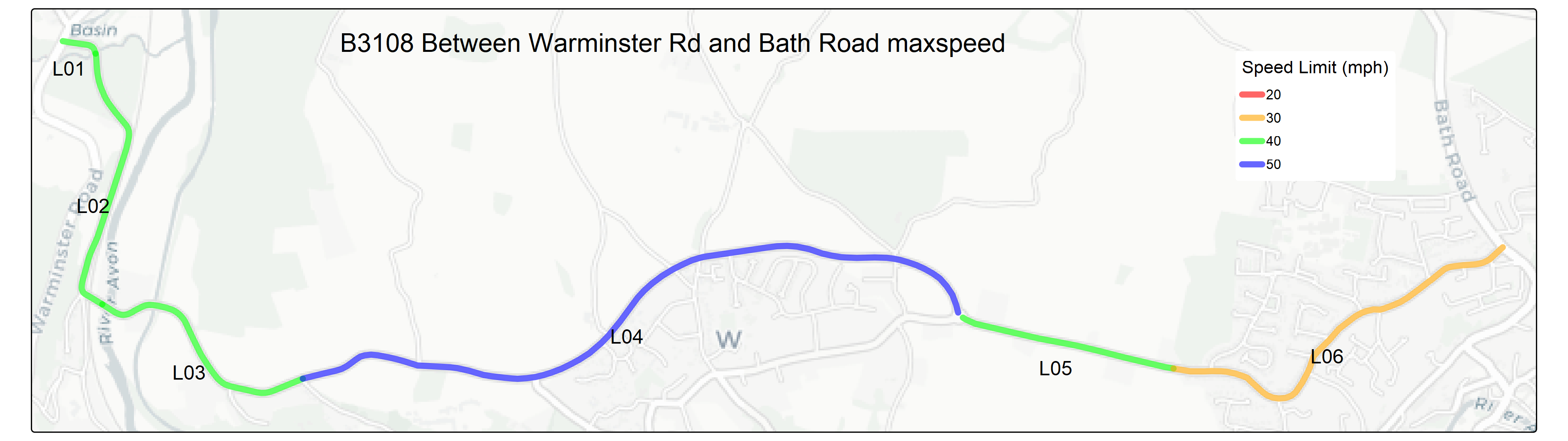
Given the complex nature of the road, with steep gradients, narrow, winding sections and proximity to residential areas there are numerous proposals. These have been broken down into scenarios
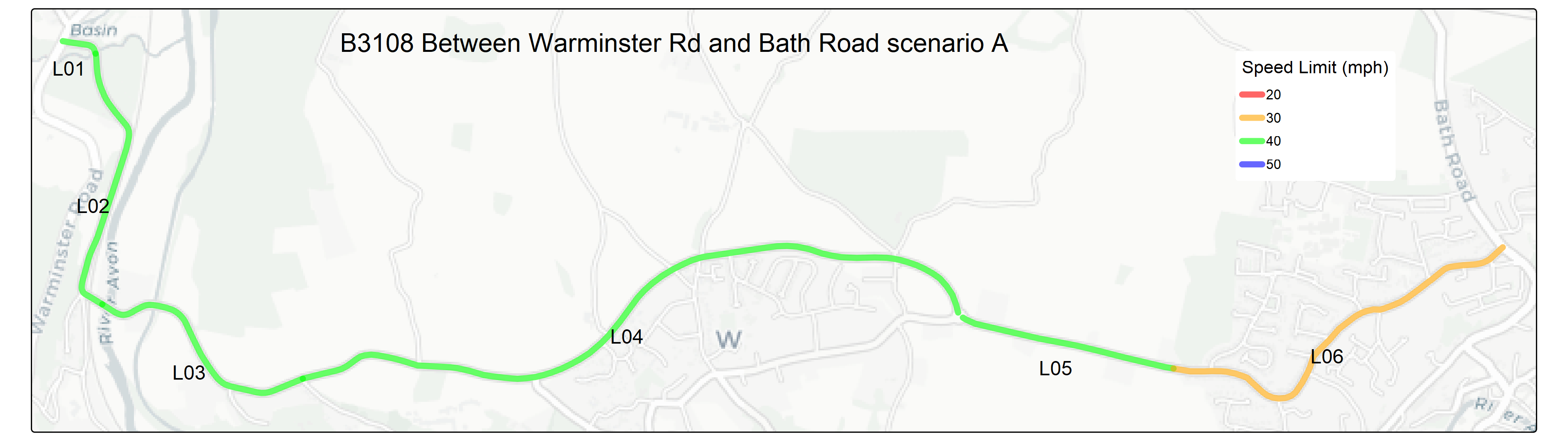
Scenario A
Reducing the 50mph section to 40mph bringing it into line with adjoining roads
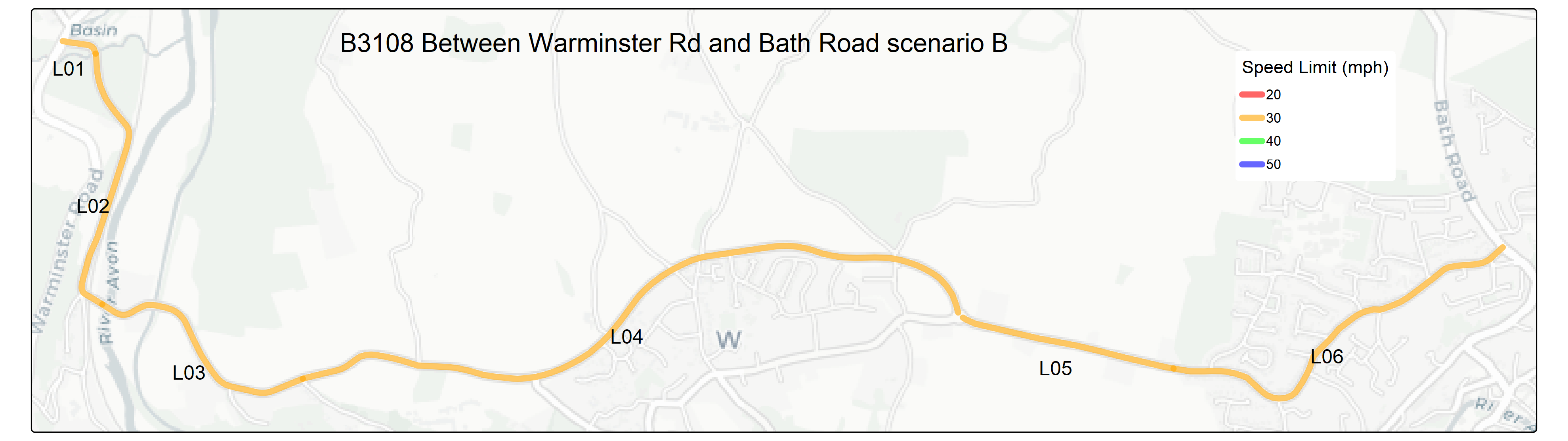
Scenario B
Reducing the speed limit along the entire stretch of road to 30mph, bringing it into line with the Eastern most segment running through Bradford on Avon.
Scenario C
30mph along the full stretch but 20mph in the most built up section through Bradford on Avon, bringing it into line with other urban areas in Wiltshire. 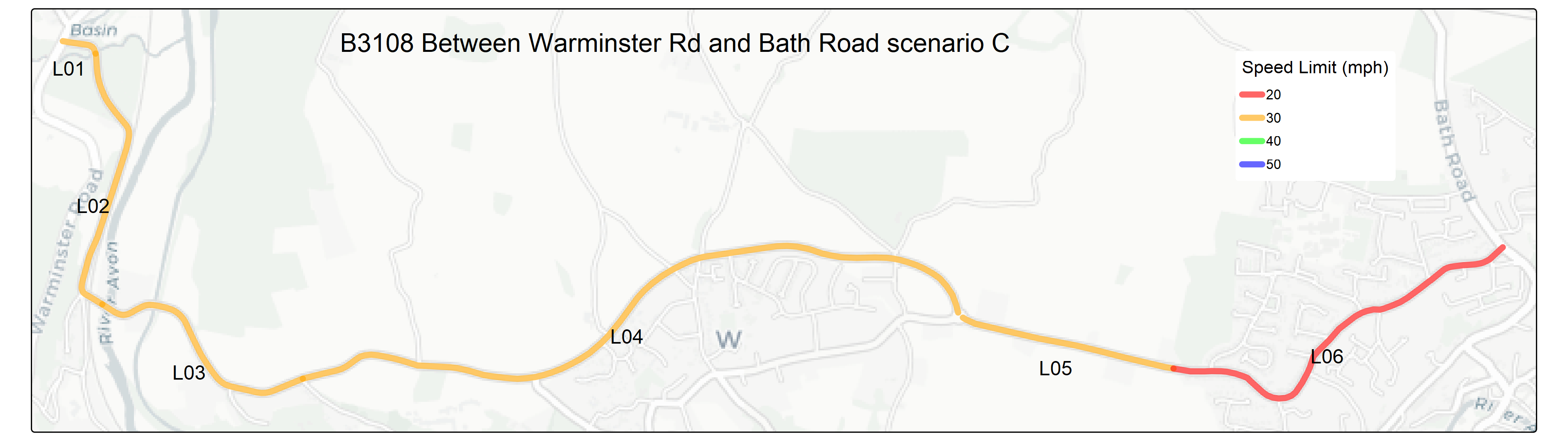
Scenario D
20 mph along the full stretch, the most effective at reducing noise and collision risk. 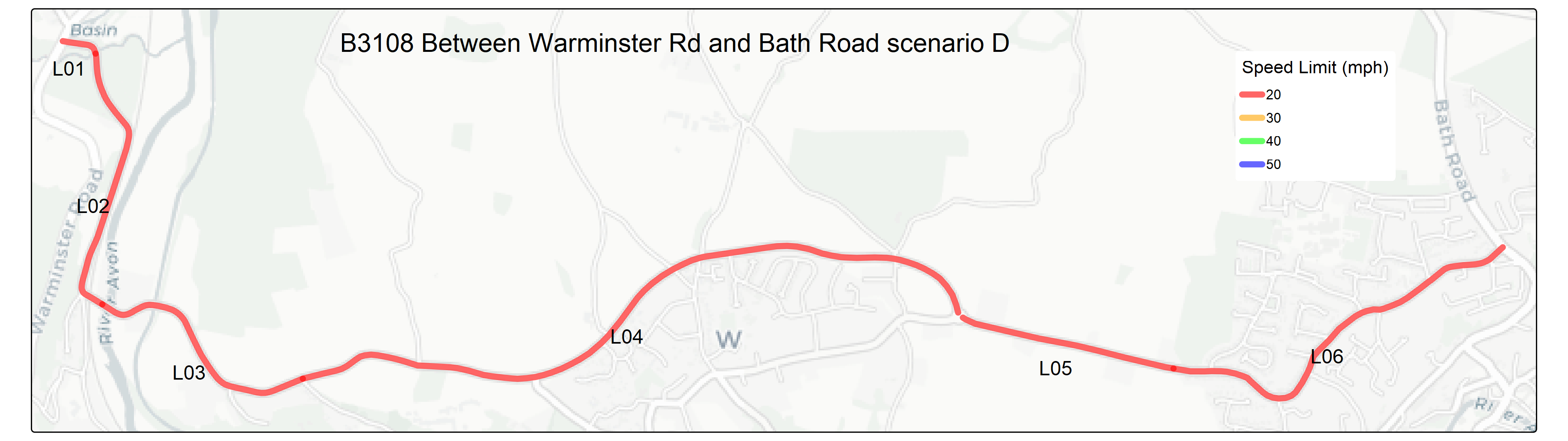
Vision Zero
A 20 mph limit may appear extreme at first glance; however, Wiltshire Council has formally committed to the principles of Vision Zero, which aims to eliminate all deaths and serious injuries on the road network. At present, the county remains a considerable distance from this ambition, with 189 people Killed or Seriously injured on the regions roads in 2024. This suggests that more decisive and ambitious measures may be required.
Vision Zero is founded on the principle that if road users comply with the rules, the transport system should be designed so that fatal outcomes are not possible. Current vehicle safety standards (Euro NCAP crash tests) require vehicles to withstand a 64 kph (40 mph) impact with a rigid barrier. Any collision occurring at higher speeds exceeds this tested safety threshold.
On rural roads, head-on collisions are a common and particularly severe crash type (as evidenced in STATS19 data). In such cases, the equivalent impact speed is the combined speed of both vehicles. Two vehicles colliding head-on at 20 mph each produces an impact broadly equivalent to a single vehicle striking a solid object at 40 mph. Speeds above this therefore significantly increase the likelihood of fatal injury, even in modern vehicles.
Population
It is estimated 3478 people live within 200 metres of the B3108. 712 of these live within 200 metres from the 50mph section. 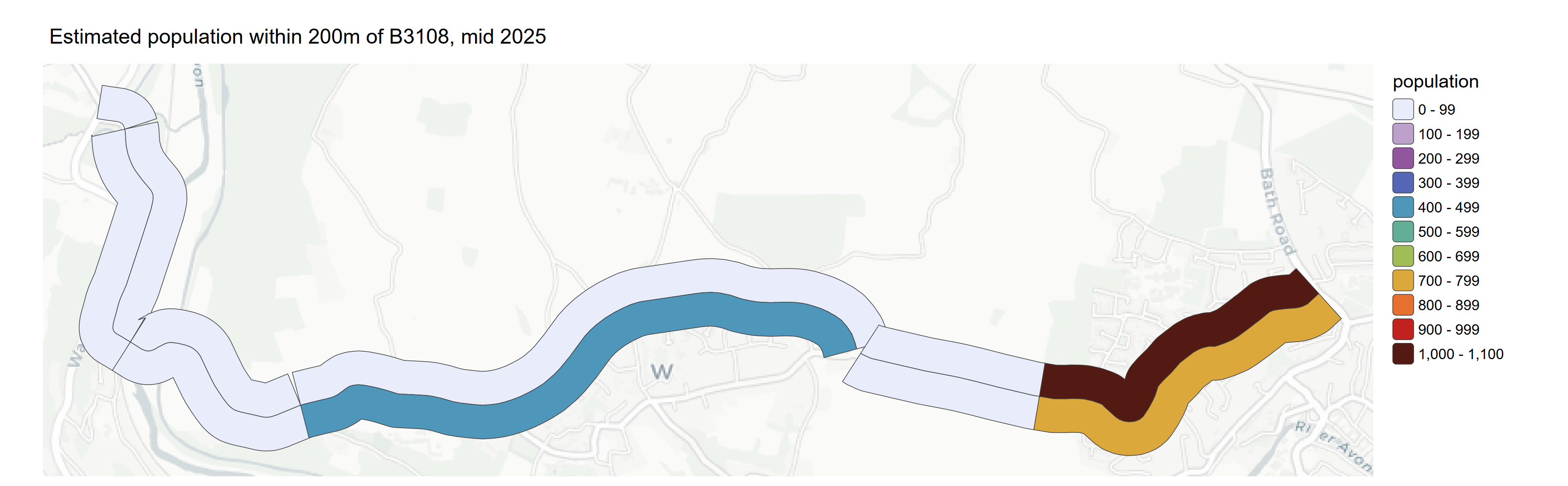
The Office for National Statistics (ONS) compiles regularly updated population data for the ‘Local Super Output Areas’ (LSOA). The plot below shows the total population for LSOA areas that intersect the B3108. 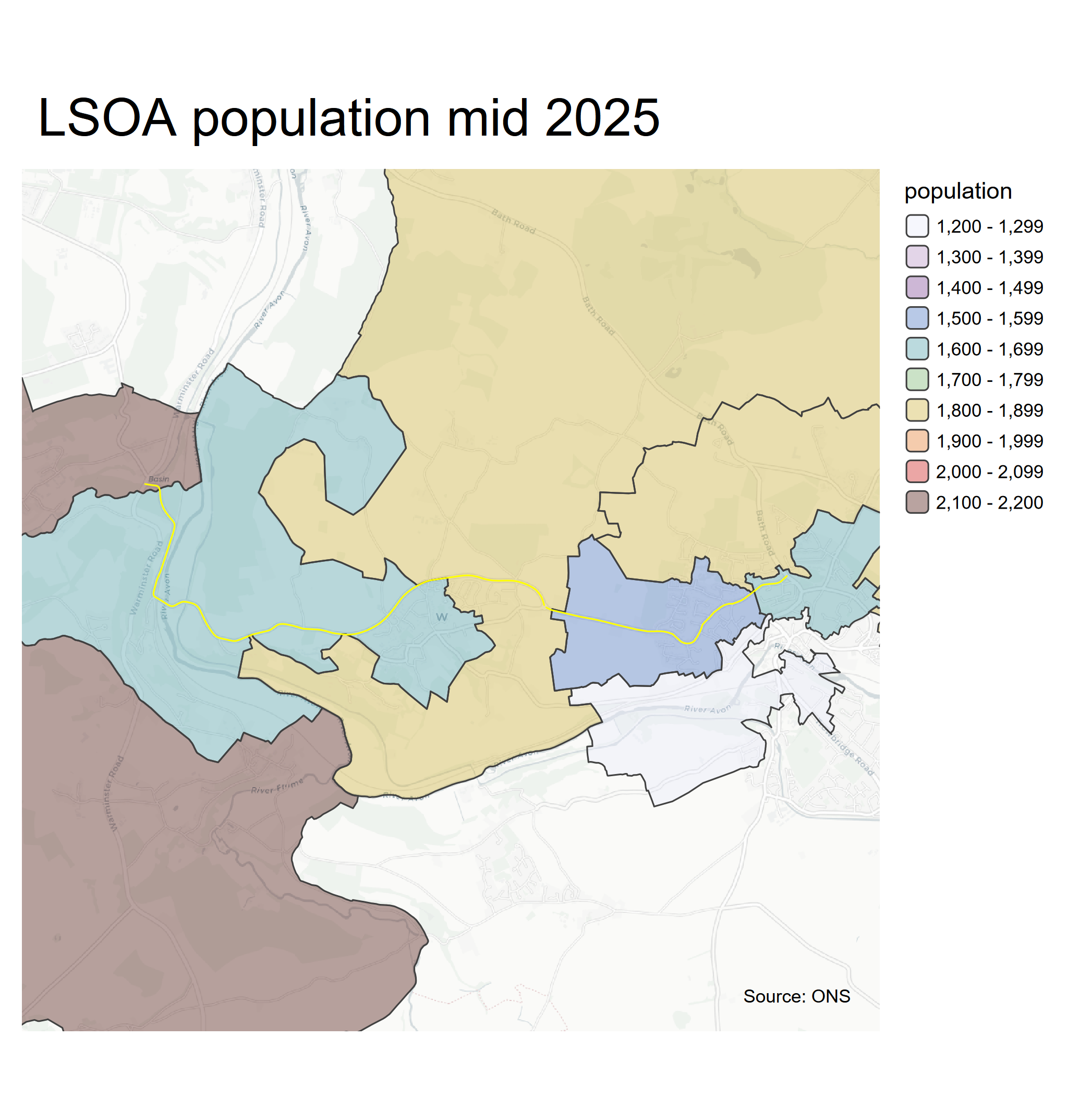 In order to estimate the population close to the road the population was distributed over the OSM buildings shapes based on the area of the buildings. The population of each building that falls within a 100m buffer of either side of the road was summed. It is estimated that just over 1400 people live within 100 metres of the B3108, the majority along Winsley Road in Bradford on Avon.
Collision costs
Between 2010 and 2024 there were 57 collisions resulting in 74 casualties reported to the Police, these are plotted below: 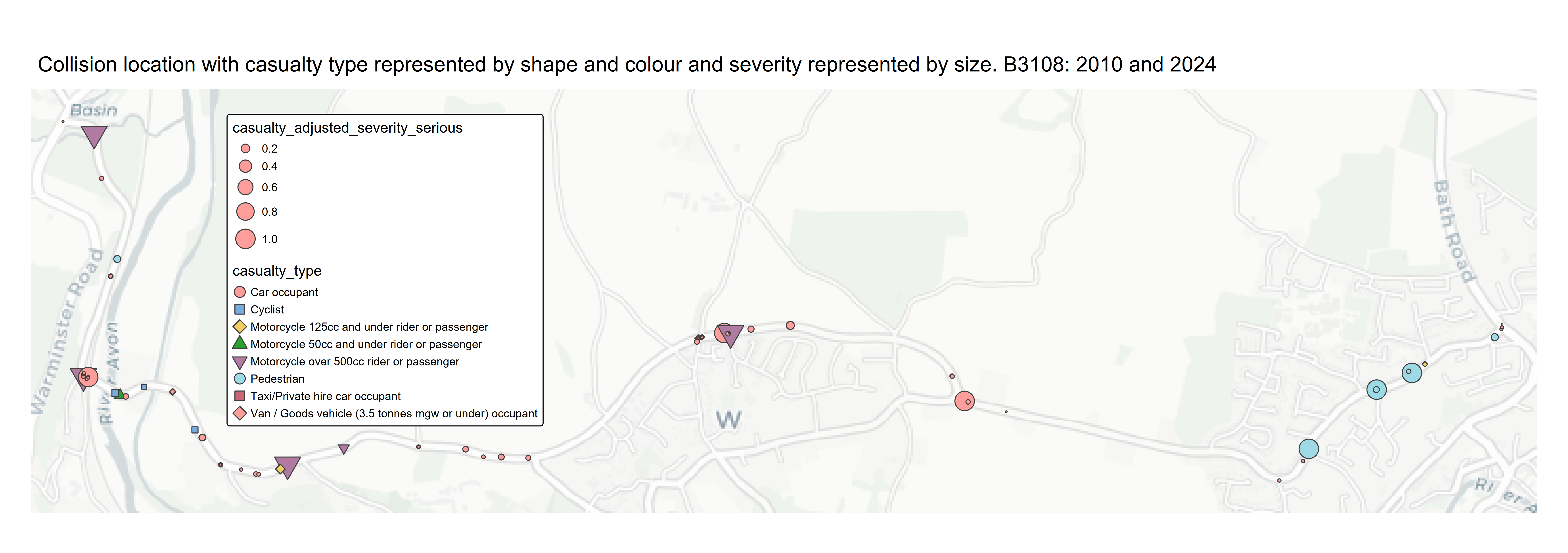 In Bradford on Avon it is mostly Pedestrians and along the bypass it is predominantly motorists and Winsley Hill Cyclists.
Noise
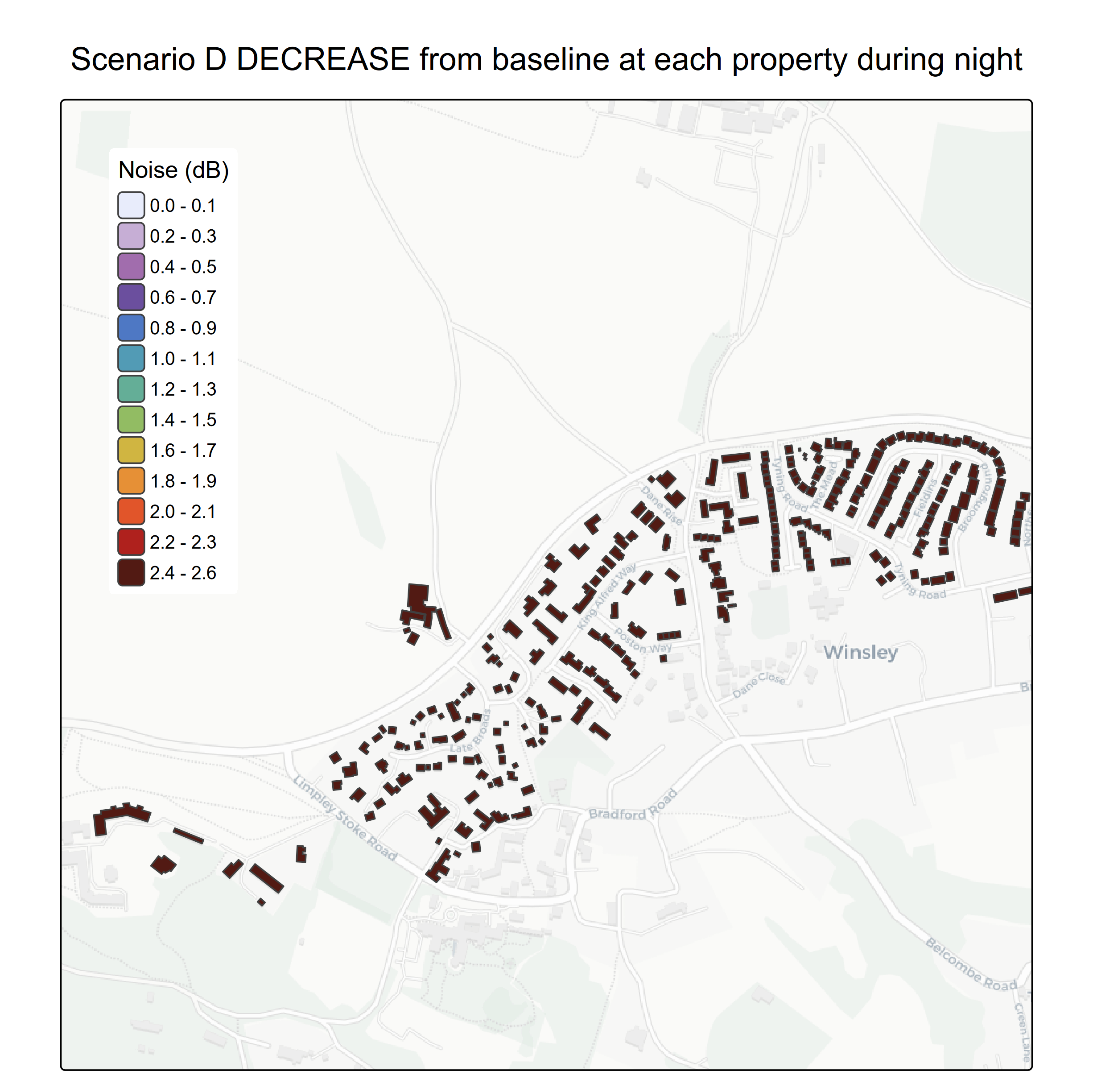
The calculation on noise is shown in the noise tab.The noise level from the vehicle counts and classes were estimated and adjusted to the facade of each building. The biggest impact would be in Winsley village with reductions of on average 2.8dB (equivalent to halving of total sound energy). 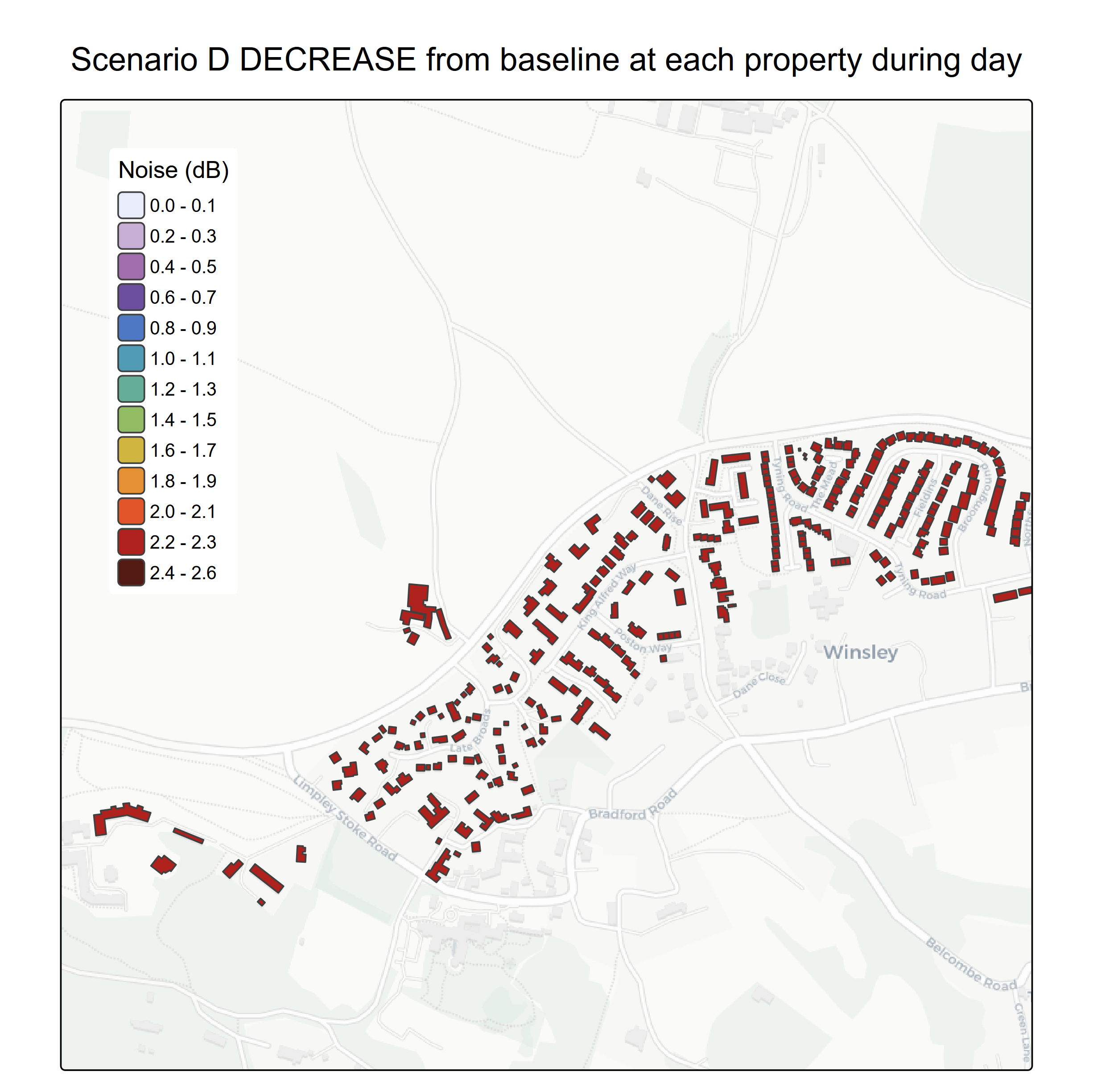
Summary
- Collision Avoidance: £245,205
- Reducing speed limit:
- Scenario A: £-30,978
- Scenario B: £567,128
- Scenario C: £727,910
- Scenario D: £4,095,025
- Noise reduction:
- Scenario A: £0
- Scenario B: £1,681,188
- Scenario C: £2,832,454
- Scenario D: £6,946,989